5 minBusiness
AI family assistants aim to ease the administrative burden on parents
Startups are launching AI-powered family assistants that can parse school newsletters, manage calendars, and coordinate household tasks. The tools promise to reduce parental stress, but researchers caution that offloading everyday logistics to apps could affect family relationships.
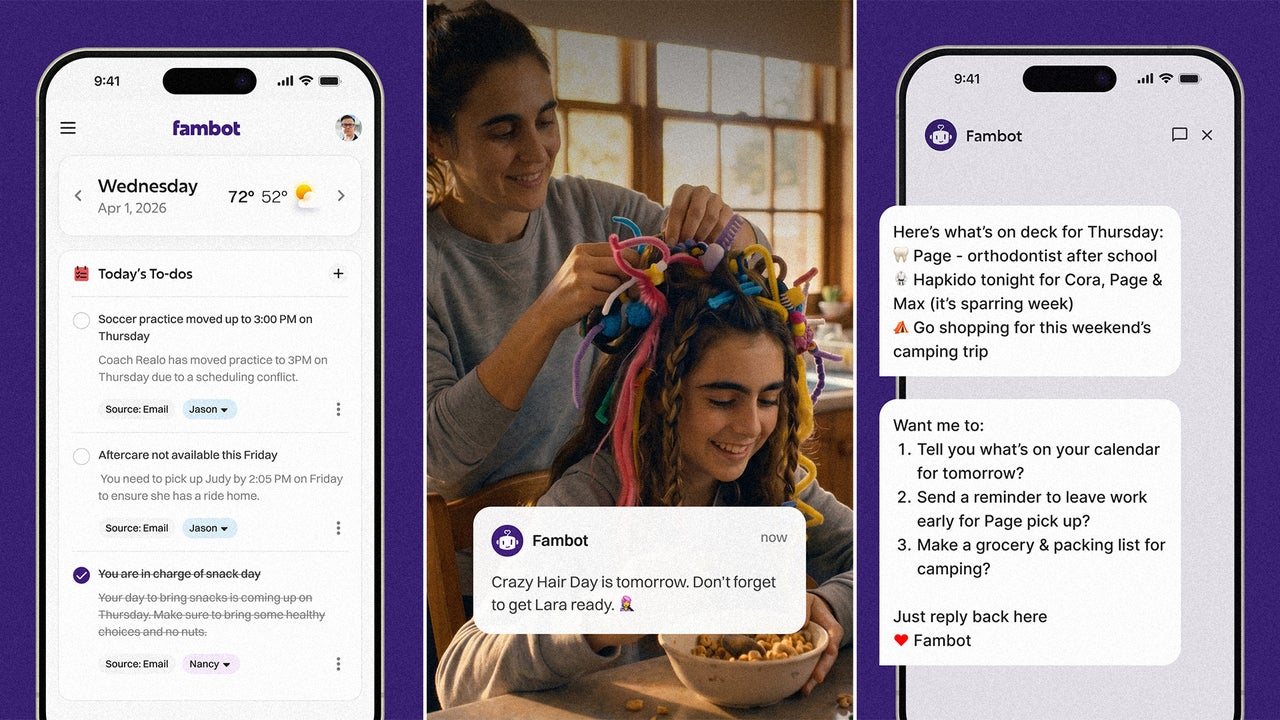
A growing number of startups are betting that artificial intelligence can take over the relentless administrative work of family life, from parsing school newsletters to coordinating soccer practice pickups. The pitch is simple: parents are drowning in emails, group chats, and app notifications, and a specialized AI assistant can filter the noise and surface what actually matters.
David Reich, founder and CEO of Fambot, says he receives between 20 and 40 emails related to his children every day and juggles about 10 WhatsApp groups. His company, which launched its AI family assistant on Tuesday, is one of several new services aiming to become a household’s digital chief of staff. Fambot had already signed up roughly 1,000 families before its public launch.
The service pulls data from email accounts, online calendars, a newly added WhatsApp integration, and other apps. It generates a daily digest of important family information, delivered by text, email, or through new Android and iOS apps. Parents can ask the AI to add events to shared calendars, check off to-do list items, or coordinate who handles which task. The assistant can also help plan events, such as generating a grocery list for a backyard cookout or preparing for a theme park visit.
Reich says a key feature is the technology’s ability to parse school newsletters, which often bury critical details inside lengthy PDFs. “You get these 12-page-long, quite adorable newsletters, but there’s like two really important things, like an early release day or the opportunity to sign up to chaperone a field trip, that’s buried in the bottom,” he said.
Fambot announced a $3.5 million pre-seed funding round led by NextView Ventures, with participation from Baukunst, Correlation Ventures, Karman Ventures, and Founders Network. It is part of a broader wave of companies offering family-focused AI assistants, including Ollie, Familymind, and Ohai. While OpenAI CEO Sam Altman has promoted ChatGPT as a parenting tool, these startups argue that specialized products are better tuned to the specific needs of parents.
The companies say their tools can relieve stress, prevent families from missing important messages from schools or sports teams, and help address the uneven division of household labor that often leaves mothers handling a disproportionate share of administrative tasks. Christy Shannon, cofounder and CMO of Ollie, said the AI can spare one parent from being the sole person parsing through information and then reminding others. Rosaria Di Donna, cofounder and CEO of Familymind, said her company’s app transfers knowledge that typically sits in one parent’s calendar and inbox into the whole family ecosystem, making it visible who needs to do what.
Privacy is a central selling point. Providers say families choose which data to import and what gets retained, and that the AI labs behind the underlying models do not keep user data. Sheila Lirio Marcelo, founder and CEO of Ohai, said her company does not work with anyone that stores the data and gives families the option to edit or delete memories the AI keeps. “We want families to opt in and feel good about it,” she said.
Researchers, however, caution that the technology is too new to know how much it will ultimately reduce parental burdens, and they warn about unintended effects on family life. Brandon McDaniel, a research scientist at the Parkview Research Center who studies family relationships, said he worries about what AI use means for the quality of relationships. “There must be balance in how we use AI and how much of ourselves, our cognition, our choices, that we turn over to the AI,” he said.
Melissa Milkie, a sociology professor at the University of Toronto, noted that research shows family members can feel neglected when people spend too much time on their phones. She said shifting real-world discussions, such as meal planning or logistics, into interactions with apps could make the problem worse. “Partners feel snubbed when people are not the focus of attention,” she said. “This is a big problem, too, between parents and kids, and so you’re inserting more technology in the kind of typical interactions that would be happening otherwise.”
68