11 minWorld
Ukraine’s Front Changed More Than the Map Shows This Summer
Russia failed to turn its 2026 summer offensive into a decisive breakthrough, but the battlefield became wider, more fragmented and more lethal as drones, infiltration teams and deep strikes reshaped how both armies fight.
The most important change on Ukraine’s front this summer is not a dramatic arrow on a map. It is the fading usefulness of the map itself.
From June through late August, Russia kept attacking across a long arc of eastern and northern Ukraine. Its troops pushed into parts of the approaches to Kostyantynivka, probed around Dobropillya and Pokrovsk, pressed in northern Sumy region and tried to create openings toward the remaining Ukrainian-held cities of the Donbas fortress belt. Yet the spring-summer offensive Moscow had prepared for months did not produce the operational rupture that would normally define a successful campaign.
The Institute for the Study of War assessed at the beginning of August that Russian forces had seized only 37.85 square kilometers in July, an average of 1.22 square kilometers a day. If zones of infiltration are added, the area in which Russian soldiers appeared rises to about 121.56 square kilometers. Even that was a fraction of the ground Russia took in July 2025.
That difference matters because a penetration is no longer the same thing as control.
Across several sectors, Russian troops have increasingly moved in groups of one, two or three soldiers, slipping through vegetation, ruins and gaps between Ukrainian positions. A few men can enter a village or a city block, hide in a basement, launch drones or wait for reinforcements without creating a continuous front behind them. Ukrainian troops can be operating a few streets away. A location may be filmed, claimed and contested before either side has the density to hold it in the older military sense.
Kostyantynivka became the clearest example of that summer battlefield.
Russian forces had been working to isolate the city for months, striking roads and bridges and trying to squeeze Ukrainian logistics. Through June and July, infiltration missions appeared in multiple parts of the city. By late August, geolocated footage indicated that Russian troops had consolidated at least a limited position in western Kostyantynivka. But they did not control all or most of the city, according to ISW, and Ukrainian forces repeatedly cleared infiltrators from areas that Russian sources had presented as advances.
The result is neither a clean siege nor a stable urban front. It is a contest for access, concealment and drone coverage inside a city that is increasingly difficult to supply and defend.
The same logic extends beyond Kostyantynivka. Around Dobropillya and Pokrovsk, the battlefield has become a patchwork of small infantry movements, drone teams, contested tree lines and roads under persistent surveillance. On August 24, ISW reported no confirmed Russian advance that day in the Dobropillya or Pokrovsk directions, even as fighting continued and Russian official statements claimed new gains nearby. Geolocated imagery showed Ukrainian forces still present in areas Russian sources had earlier described as controlled.
This does not mean the pressure is unimportant. It means the pressure is being applied differently.
For much of the war, military reporting treated the front line as a ribbon: one army here, the other there, with artillery and trenches behind each side. By summer 2026, that ribbon had widened into a belt of danger.
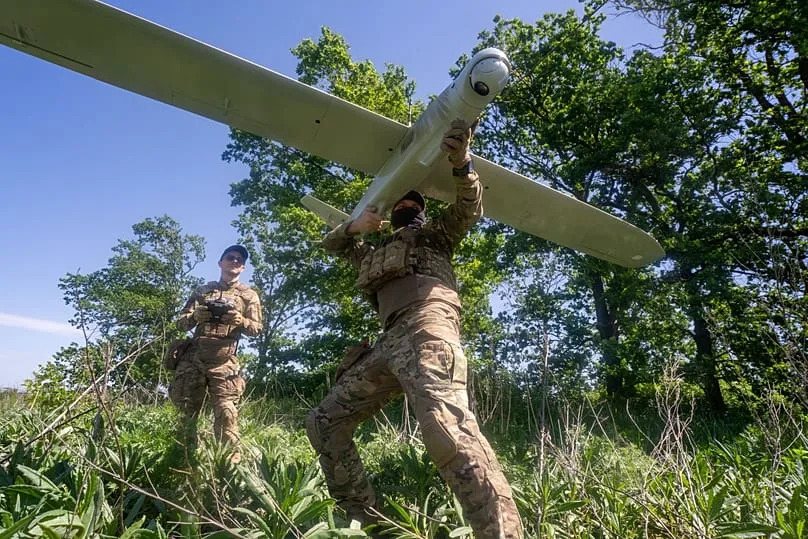
A recent CSIS analysis described a near-front “kill zone” that can extend as far as roughly 30 kilometers from the line of contact. In that space, drones watch roads, target vehicles, hunt artillery, follow soldiers and disrupt evacuation. The strongest position is increasingly not a concrete trench but a hidden drone team with communications, power and access to replacement aircraft.
Ukraine has formalized that idea in its own drone doctrine, but Russia has been scaling the same tools. A Ukrainian military source cited by ISW in August said Russian forces were launching between 1,500 and 2,000 radio-controlled FPV drones every day against Druzhkivka and two logistics routes, plus about 1,200 a day in the Dobropillya direction. Those figures did not include fiber-optic drones, which are harder to jam.
At that density, movement itself becomes a tactical decision. A truck that once drove ammunition to a position may now be detected long before it arrives. A wounded soldier may have to wait for darkness or bad weather. Infantry can spend days moving a distance that armored units once covered in hours.
That helps explain one of the summer’s central paradoxes: Russia kept attacking and losing men, but the front did not accelerate.
According to the Ukrainian General Staff, Russian forces suffered 42,860 casualties in July, the highest monthly total of 2026 at that point. The number is a Ukrainian military estimate rather than an independently audited count, but even without accepting it as exact, the broader pattern is clear in open-source reporting: Moscow has been paying heavily for limited territorial movement.
ISW assessed that Ukrainian counterattacks, drone dominance and intermediate-range strikes were among the reasons Russian forces could not translate pressure into maneuver. Mechanized assaults still occurred, but they were comparatively rare and did not yield major gains in July.
Ukraine’s own adaptation has pushed the battlefield farther into the Russian rear.
An Associated Press report in July described Ukrainian mid-range drones hunting vehicles and logistics nodes far behind the immediate front. This is not the spectacular deep-strike campaign against refineries hundreds of miles inside Russia. It is a more operationally direct layer of warfare: hitting trucks, depots, command posts, drone sites and roads 20, 40 or 80 miles behind Russian assault groups.
Those attacks can matter more to the front than a headline strike on Moscow. They force Russian supplies to disperse, extend the distance soldiers must walk, complicate rotations and reduce the amount of ammunition and equipment that can reach forward units quickly.
Meanwhile, Ukraine has also expanded the deeper campaign. Financial Times reporting this summer described a record pace of Ukrainian strikes on Russian energy infrastructure, including 16 successful refinery strikes in May and at least 194 strikes on energy targets since the start of the year at the time of publication. The aim is broader than battlefield interdiction: it is to raise the economic and logistical cost of sustaining the war.
Russia has answered with mass.
Its long-range missile and drone campaign intensified over the summer, with July producing a record number of missile launches according to ISW. The pressure became particularly dangerous as Ukraine’s stock of Patriot interceptors tightened. August attacks again demonstrated the asymmetry: Ukraine can cheaply intercept many drones, but ballistic missiles force it to spend scarce, sophisticated air-defense ammunition or accept the risk of strikes on cities and infrastructure.
The ground war and the air war are therefore converging. Russia wants to make Ukrainian logistics, energy and civilian life more difficult from hundreds of miles away while its small assault groups search for weak points at the front. Ukraine wants to make Russian logistics and energy more difficult far behind the line while drones and counterattacks deny those assault groups the mass needed for a breakthrough.
Northern Sumy region shows the limits of reading the summer as a simple Ukrainian success. Russian forces still made localized advances there in August, and the pressure along the border remains real. But Ukrainian counterattacks continued, and ISW cited reporting that some Russian formations needed additional special-forces manpower to reinforce the sector. The operation has not developed into a major drive on Sumy city.
The same caution applies in Donetsk region. Russia has not achieved the decisive summer breakthrough it sought, but Kostyantynivka is in a worse position than it was in early June. The city is increasingly penetrated by small groups, its roads are under heavier drone threat and the wider fight is moving toward the northern fortress belt around Druzhkivka, Kramatorsk and Slovyansk.
The summer therefore changed the war in two directions at once.
Strategically, Russia’s offensive underperformed. It did not generate operationally significant territorial gains, and its rate of advance remained far below the previous year. Tactically, however, the front became more dangerous for Ukraine because the line itself became porous. Russian troops can appear behind a nominal forward position without controlling the territory between. Drones can close a road without physically occupying it. A city can be partly infiltrated without being captured.
For Washington and other Ukrainian partners, that distinction is crucial. A map showing limited Russian movement can support the conclusion that Ukraine’s defenses are holding. It should not support the conclusion that the battlefield has stabilized in the old sense.
The real measure of the next phase will be whether Russia can convert infiltration into sustained force concentration around the Donbas fortress belt, or whether Ukraine can continue turning those penetrations into isolated pockets while striking the logistics that feed them.
By late August, the answer was still unresolved. Russia had changed the geometry of the front more than it had changed the border of occupied territory. Ukraine had denied a summer breakthrough but had not removed the threat to Kostyantynivka or the roads beyond it. The map moved slowly. The war around the map accelerated.
76