4 minWorld
Trump Tells U.N. Iran Faces Choice Between Deal and Destruction
In his address to the U.N. General Assembly, President Trump said Iran must choose between a negotiated agreement and being 'annihilated,' while Secretary-General António Guterres urged world leaders to end conflicts.
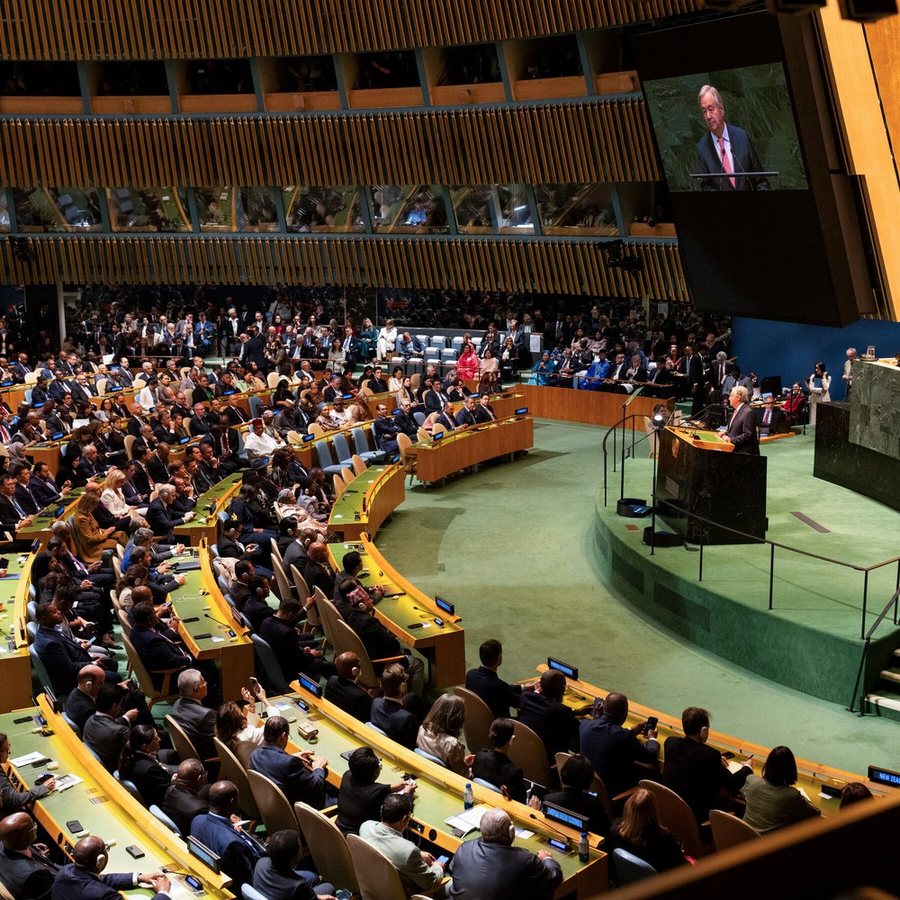
President Trump used his address to the United Nations General Assembly on Tuesday to deliver a stark ultimatum to Iran, saying the country must either reach a deal or face being «annihilated.» He declared that Tehran had been «the bully of the Middle East, but they are the bully no longer,» according to his remarks before the assembled world leaders.
The speech, delivered at the U.N. headquarters in New York, marked one of the most direct public warnings from the U.S. president toward Iran in recent months. Trump framed the choice as binary, telling the assembly that the decision rests with Tehran. He did not elaborate on what specific terms a deal would require or what timeline he envisioned, leaving diplomats and observers to parse the implications of his words.
Earlier in the same session, U.N. Secretary-General António Guterres called on the General Assembly to end conflicts around the world, setting a somber tone for the annual gathering of heads of state and government. Guterres has repeatedly used the platform to press for ceasefires and diplomatic solutions to ongoing wars, and his remarks underscored the tension between his appeals for peace and the confrontational language that followed from the U.S. president.
The General Assembly, which brings together leaders from nearly every nation, is traditionally a venue for broad statements of principle and multilateral cooperation. This year's session has been dominated by the war in the Middle East and the broader security challenges facing the international community. Trump's comments about Iran quickly became the focal point of the day's proceedings, drawing attention away from other agenda items.
Iran has not yet issued a formal response to the president's remarks. The Iranian delegation was present at the assembly, and its reaction, or lack thereof, is being closely watched by other member states. The U.S. has maintained a policy of maximum pressure on Iran, and Trump's language on Tuesday suggested that approach remains firmly in place.
The president's address also comes amid a broader diplomatic push at the United Nations, where leaders are grappling with multiple crises, including the conflict in Gaza, the war in Ukraine, and tensions in the South China Sea. Trump's focus on Iran, however, signaled that his administration views Tehran as a central concern. His statement that Iran is «no longer» the bully of the Middle East implied a shift in the regional balance of power, though he did not provide details on what had changed.
World leaders gathered in New York are expected to continue bilateral meetings on the sidelines of the assembly, with Iran likely to be a topic of discussion in several of those sessions. The U.S. delegation has not announced any planned direct talks with Iranian officials. European allies, who have sought to preserve the nuclear agreement that Trump withdrew from in 2018, are likely to seek clarification on the president's intentions.
The choice Trump described — a deal or annihilation — echoes language he has used in the past regarding North Korea and other adversaries. It remains unclear whether the remarks were intended as a negotiating tactic or a genuine threat of military action. The White House did not immediately provide additional comment on the president's speech.
As the General Assembly continues, the international community will be looking for signs of whether Trump's words translate into a concrete policy shift or remain a rhetorical escalation. For now, the president has placed the decision squarely before Iran, with the world watching.
4