5 minWorld
Serbia's Vucic Faces Stiffest Election Test as Student Movement Challenges His Rule
Serbian President Aleksandar Vucic resigned in September and is running for prime minister in an October 25 snap election, facing an unprecedented challenge from a decentralized student-led opposition born out of anti-corruption protests.
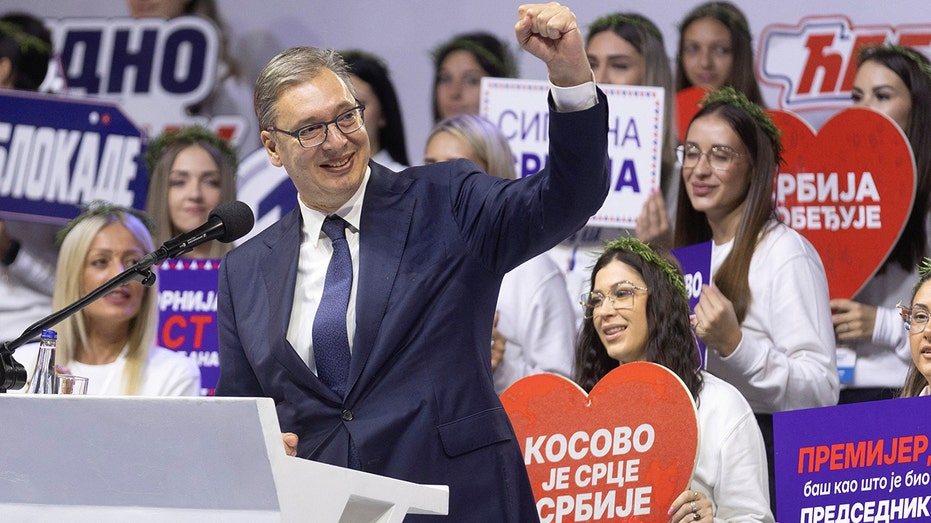
Serbian President Aleksandar Vucic is facing the most serious political challenge of his 14-year rule, as a student-led opposition movement contests an October 25 snap parliamentary election that could reshape the country's political landscape.
Vucic resigned from the presidency and dissolved parliament in September, setting the stage for the early vote. Term-limited under Serbia's constitution after serving as president since 2017, he is now running for prime minister, a post he previously held from 2014 to 2017. The maneuver allows him to remain in power despite the presidential term limit.
The election is widely seen as one of the most competitive in Serbia's recent memory. Unlike previous votes, the opposition is not led by the country's traditional parties, which struggled for years to mount a credible challenge to Vucic and his Serbian Progressive Party. Instead, the so-called Student List has emerged from a spontaneous protest movement that began in November 2024 after the collapse of a railway station canopy in the town of Novi Sad killed 16 people.
The protests, which became some of the largest in Serbia's history, demanded justice and accountability for the disaster. A demonstration on March 15, 2025, drew nearly 350,000 people to Slavija Square in central Belgrade. When none of the protesters' original demands were met and the government continued a heavy-handed crackdown on demonstrators, the students turned to electoral politics.
Helena Ivanov, an associate fellow at the Henry Jackson Society, said the student protesters have succeeded where the established opposition failed. «The student protesters have been able to capture the hearts and minds of people and keep the momentum going in a way that the established opposition was never able to do,» she said, describing the vote as «certainly the biggest challenge» for Vucic in his 14 years in power.
The Student List operates in a decentralized manner and has no official leader. It draws from a broad swath of civil society, many from academia, and excludes figures from Serbia's traditional opposition parties. Its main priorities are tackling corruption and promoting transparency and the rule of law.
Foreign Minister Marko Djuric dismissed the opposition's prospects, saying the public has seen through the students. «Years of criticism have not persuaded the public that they have a credible program or a serious plan for the country's future,» he said. Djuric instead pointed to Serbia's economic performance under Vucic and a Strategic Dialogue with the United States that he said would foster greater cooperation and new opportunities for Serbs.
Vucic has long touted economic growth as evidence of the country's transformation. In an interview earlier this year, he said Serbia's gross domestic product had grown from 32 billion euros when he first became prime minister to more than 100 billion euros, or about $120 billion. He has also emphasized improving relations with Washington centered on economics, investment, technological cooperation and shared conservative values.
In Congress, a bipartisan group of lawmakers led by Sen. Chuck Grassley, R-Iowa, and Sen. Richard Blumenthal, D-Conn., introduced the SRBIJA Act to address democratic backsliding in Serbia, promote the rule of law and accountability, and improve the treatment of student-led civic protests. The legislation would condition future aid on a presidential certification that Serbia made «significant and sustained» efforts toward judicial accountability, press freedom and alignment with the European Union and NATO.
Concerns are growing in Congress and among observers that the election will take place in a hostile environment and that efforts to discredit and undermine the vote are already underway. Some fear the current government might not respect the outcome if the Student List were to win.
As president, Vucic straddled the geopolitical line between East and West, seeking European legitimacy and launching EU accession talks in 2014 while maintaining close ties with Russian President Vladimir Putin even after the full-scale invasion of Ukraine in 2022. The election will test whether that balancing act, and his long dominance of Serbian politics, can survive a movement that has mobilized popular support in a way no established party could.
7