5 minSociety
Harry Houdini’s 1926 death still raises questions a century later
A century after Harry Houdini died on Halloween 1926, the official cause of his death remains debated, with theories ranging from a stomach punch to a blockage or retaliation by spiritualists.
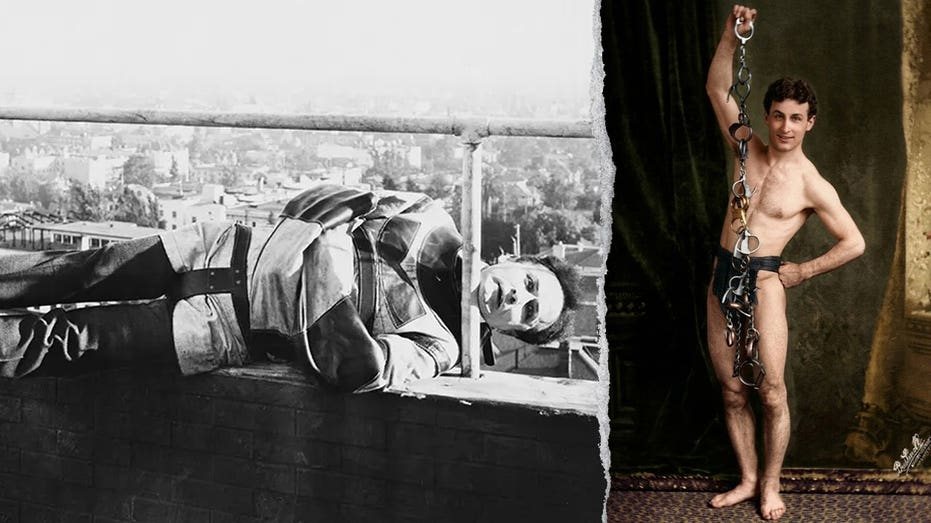
A century after Harry Houdini died on Oct. 31, 1926, questions about how the famed escape artist and vaudeville performer came to his end continue to draw interest from historians and fans. Officially, Houdini died at 52 of peritonitis, an infection caused by a ruptured appendix. Yet the circumstances that led to that outcome have never been fully settled, and alternative explanations have circulated since the day he died.
Houdini, born Erik Weisz in Hungary, immigrated with his family to the United States at age 4 and went on to become one of the most famous magicians and performers in history. He was known for his physical conditioning and daredevil stunts, which frequently brought him close to danger. Among the theories that have endured is that a surprise blow to his stomach caused the fatal appendicitis, while others point to an intestinal blockage. Some have suggested he was targeted by people working as spirit mediums, whom he had been publicly exposing as frauds shortly before his death.
The most widely held account of the events centers on Oct. 22, 1926, nine days before he died. A university student named J. Gordon Whitehead visited Houdini in his dressing room at a Montreal theater. Historians report that Houdini was reclining on a couch when Whitehead asked to test his ability to withstand a blow to the stomach. Before Houdini could brace himself, Whitehead began punching him. The punches continued until another person in the room asked Whitehead to stop, according to Roger Dreyer, president of Houdini Revealed, a museum in New York.
Many historians agree that Houdini ignored symptoms of appendicitis that followed, according to John Cox, a Houdini historian and biographer. Although some believed the blows caused the deadly inflammation, that link was never proven. "He didn't get it treated in time," Cox said. "His appendix ruptured. This caused peritonitis, which was a massive infection. And back then, you died from that." Cox added that the punch was likely a poorly timed accident that led Houdini to dismiss what was really happening to his body.
The episode also had financial consequences for his family. Houdini was thousands of dollars in debt at the time of his death. Because the punches were blamed for his death, his life insurance policy paid out double, according to Dreyer. He said the policy carried a $25,000 payout, with an additional $25,000 if death resulted from an accident. Dreyer noted that $25,000 at the time was worth almost $500,000 in today’s value.
Houdini had long been preoccupied with death, Dreyer said, because his daredevil acts often brought him to its edge. He also spent years exposing people who claimed to communicate with the dead, which he believed were scams that preyed on grieving people. He faced defamation lawsuits as a result. He and his wife, Bess Houdini, had agreed that if one of them died, they would try to contact the other. After his death, Bess held seances every Halloween for 10 years, but when none succeeded she concluded that contact with the dead was not possible.
A common myth about his death stems from a 1953 film that portrayed Houdini as unable to escape a Water Torture Cell in time to save his own life, a depiction that does not reflect the documented events. Cox said the lack of a definitive account has left room for speculation and conspiracy theories, which continue to this day. Houdini’s story is also being revisited in the new three-part Fox Nation series "Houdini: Back from the Dead," which uses artificial intelligence to have him appear in a modern-day interview.
Dreyer said interest in Houdini endures because of how he lived rather than how he died. He described Houdini as a pop icon and one of the top social influencers of his era, whose name remains synonymous with escaping difficult situations. Cox said the escapes still fascinate people who have studied them for decades. "We're still trying to figure out how Houdini did what he did."
5