6 minSociety
AI Could Bring Objectivity to College Admissions, Commentator Argues
A Fox News opinion piece argues that artificial intelligence should be deployed in college admissions offices to reduce bias, cut costs, and restore trust in a process clouded by controversy over race-conscious policies.
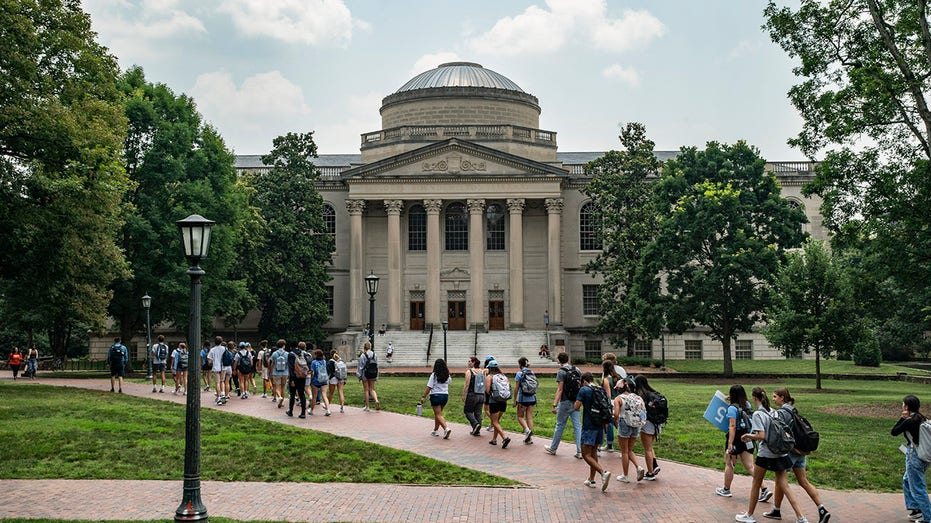
Artificial intelligence could replace much of the work done by college admissions staff and, in the process, make the selection process fairer and more transparent, according to a Fox News opinion column by Hugh Hewitt. The piece argues that admissions offices are a prime candidate for AI-driven automation, not only to save money at financially strained institutions but also to reduce the influence of subjective human judgment that has made the process increasingly controversial.
Hewitt points to data from the College and University Professional Association for Human Resources, which released a study in April 2023 covering 12,042 admissions employees at 940 institutions. On average, each institution employed more than a dozen admissions staff members. With more than 4,000 degree-granting institutions in the United States, Hewitt estimates the workforce at no fewer than 40,000 people — a group he says AI is coming for. He acknowledges that even at institutions facing the deepest cost-cutting pressure, a few admissions officers will still be needed, so the job loss would not be total.
The column argues that the application process is driven by paper and numbers: test scores, grade point averages, essays, resumes, and recommendations from tens of thousands of young people competing for a prized result. Almost all applicants hope for a fair process, Hewitt writes, and the sorting and scaling of numerical data is exactly what AI can compile and assess in hours or even minutes. He suggests that AI could sort resumes and recommendations by truthfulness, quality, and sincerity, and comb through essays for originality as well as evidence of outside assistance.
Beyond raw numbers, Hewitt says AI can be assigned weights for factors that are legitimate indicators of merit beyond academic achievement, such as in-state or out-of-state status, gender, family income, the difficulty of life circumstances, and the need for broad geographic and class diversity. Models can also be trained to evaluate grades and performance based on the nature of the secondary school or college attended. Crucially, he writes, AI can be instructed to give no weight to applicants' race, ethnicity, or religion — characteristics whose use in admissions is restricted by federal law and Supreme Court precedent.
The opinion piece also notes that athletic ability and legacy status are legitimate factors, as are musical and theater talent, forensics, and foreign-language fluency. Hewitt contends that AI would be far better than young admissions officers at modeling an incoming class and targeting the long-term success of that applicant pool on campus and in later lives. He adds that AI could help assure donors, college evaluators, and courts that the admissions process is not tainted by prohibited screens. A school seeking a strong defense against lawsuits challenging its admissions process, he argues, would benefit greatly from laying out its AI model's weights, even if the model's results are not the final word.
Schools must weigh many factors beyond academic chops, including the ability to pay tuition, the likelihood of employment after graduation, and the likelihood that a particular applicant will become a financial supporter over the years. Reputation matters greatly, too, as the benefit of network effects for a student body is real. Hewitt says AI can be coached to weight markers for all these things, including how much an applicant has worked and whether he or she is a first-generation college student — two indicators generally thought to be predictive of life success.
The application process has become clouded in recent decades by suspicion of politicization and the use by admissions officers of controversial factors such as race, a practice the Supreme Court has significantly restricted. Hewitt argues that the collective process across the country could use a large dose of objectivity and a consequent rise in trust in the results. An AI-driven admissions process that is transparent to outside evaluators, he writes, would be a welcome evolution in the increasingly controversial question of choosing elites.
As for the roughly 40,000 employees whose jobs could be affected, Hewitt asks what they do now: sort, sift, and make recommendations to higher-ups, deploying judgment and allowing their own biases to play out across a vast ocean of applicants. Everyone, including those workers, would be better served doing work that can be objectively evaluated and that does not encourage the exercise of subjective judgment, he writes. AI should be welcomed in any job category where a mass of data must be objectively analyzed, according to the column. At a minimum, colleges and universities should want to deploy a parallel admissions process run by AI alongside their existing structure, Hewitt concludes, calling a side-by-side comparison of accepted applicants an interesting and illuminating prospect.
5