4 minNews
UPSA Launches Century-Long Eclipse Database Ahead of Aug. 12 Totality
The Ukrainian project contains 457 calculated solar and lunar eclipses through 2126 and an interactive city-based simulator. Its public debut comes one day before totality reaches Iceland and Spain.
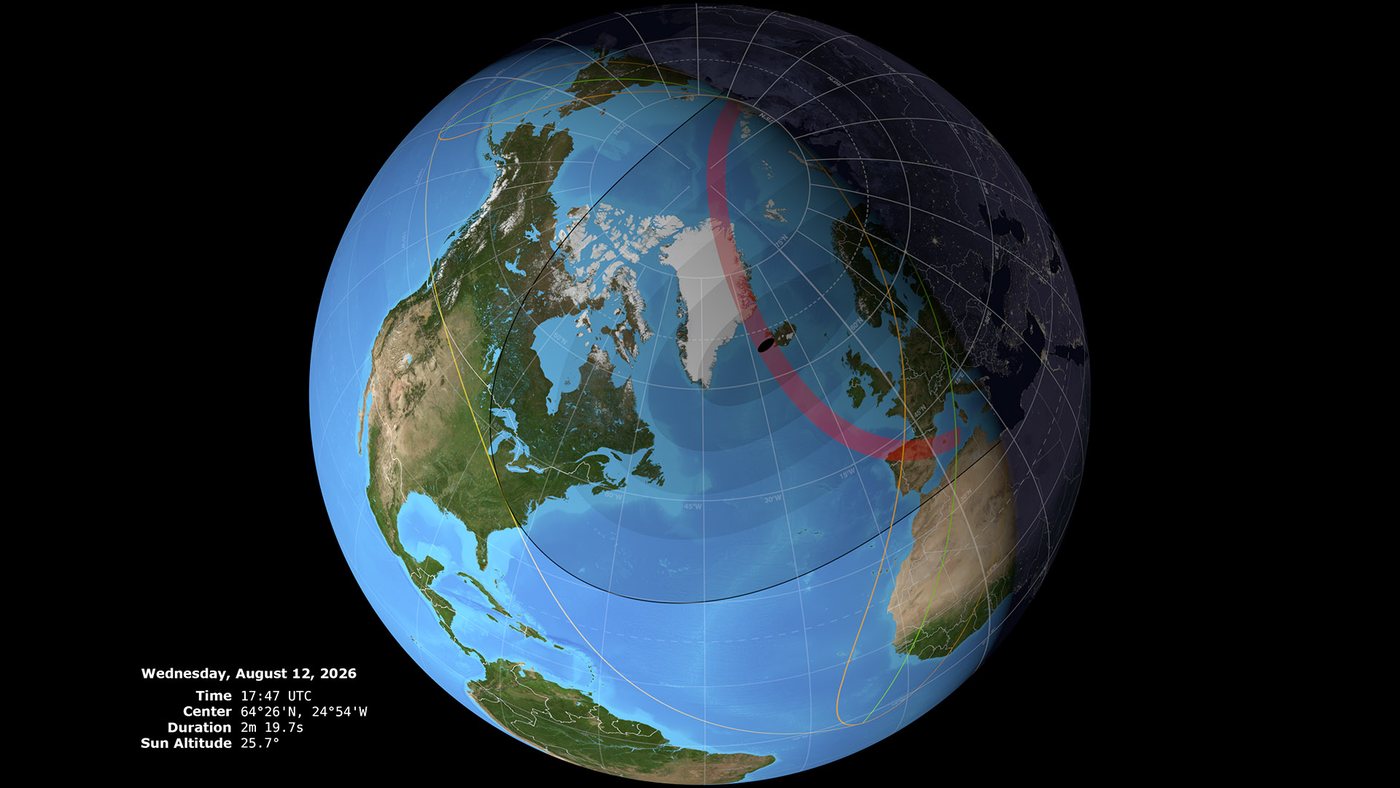
Ukrainian Private Space Agency has launched a free public database of solar and lunar eclipses covering the next 100 years, timing the release to the total solar eclipse that will cross Iceland and Spain on Aug. 12.
Eclipse Almanac contains 457 events from 2026 through 2126 and visibility calculations for 284 cities. Science Official published the first in-depth report on the service.
The catalog includes 227 solar eclipses — 72 total, 73 annular and 82 partial — along with 230 lunar eclipses. Rather than functioning only as a date list, the service allows users to select a city, filter the catalog to events visible there and simulate the eclipse from that location.
The simulator offers three presentations of the same calculation. A wide view shows the sky and major celestial objects from the observer’s position. A close view focuses on the solar and lunar disks. A technical view gives contact times, angular sizes, altitude, azimuth and related positional data.
Users can move through an event on a timeline, jump among eclipse phases and accelerate the clock up to 3,600 times. A current-time control can synchronize the display during a real eclipse.
The project says it uses the open-source Astronomy Engine library for solar and lunar positions and recalculated its catalog instead of copying a preexisting table. The same engine runs in the browser, so changing the time or city updates the geometry dynamically. The rendering layer uses WebGL.
The Aug. 12 event provides a near-term public check. Totality crosses Greenland, Iceland, the Atlantic and Spain, with a small part of Portugal also in the total path. The Almanac places Reykjavik and five Spanish catalog cities — A Coruña, Bilbao, Zaragoza, Valencia and Palma — inside totality. A much wider region experiences a partial eclipse.
The service gives greatest eclipse at 17:45:46 UTC near 65.22 degrees north and 25.25 degrees west. NASA’s published eclipse elements place the maximum at nearly the same coordinates and only a few seconds later. The project’s maximum-duration calculation differs by several seconds from NASA’s canonical value, which can result from different conventions for the apparent lunar edge.
For Ukraine, the database reports no observable total solar eclipse anywhere in the country between 2026 and 2126 after checking 515 points against all 72 total solar eclipses in the century set. On Aug. 12, western cities instead see a partial eclipse near sunset, while many central, southern and eastern locations lose the event to the horizon.
UPSA is not attaching public claims about staff size, budget or partners to the launch. The verifiable objects are the services: a multilingual catalog, a computational model and a browser interface, alongside UPSA Radar, the agency’s live map of tracked objects in Earth orbit.
Direct solar viewing still requires proper protection. Ordinary sunglasses are not safe for watching a partial eclipse, and optical devices require front-mounted solar filters. The software can make the timing and geometry easier to understand, but the physical rules of observing the Sun remain unchanged.
82