6 minNews
Air Force Explores AI Data System for Minuteman III Fleet
A new request for information seeks industry input on a tool that would connect roughly 60 maintenance and engineering data sources. The notice does not give AI a missile-launch role.
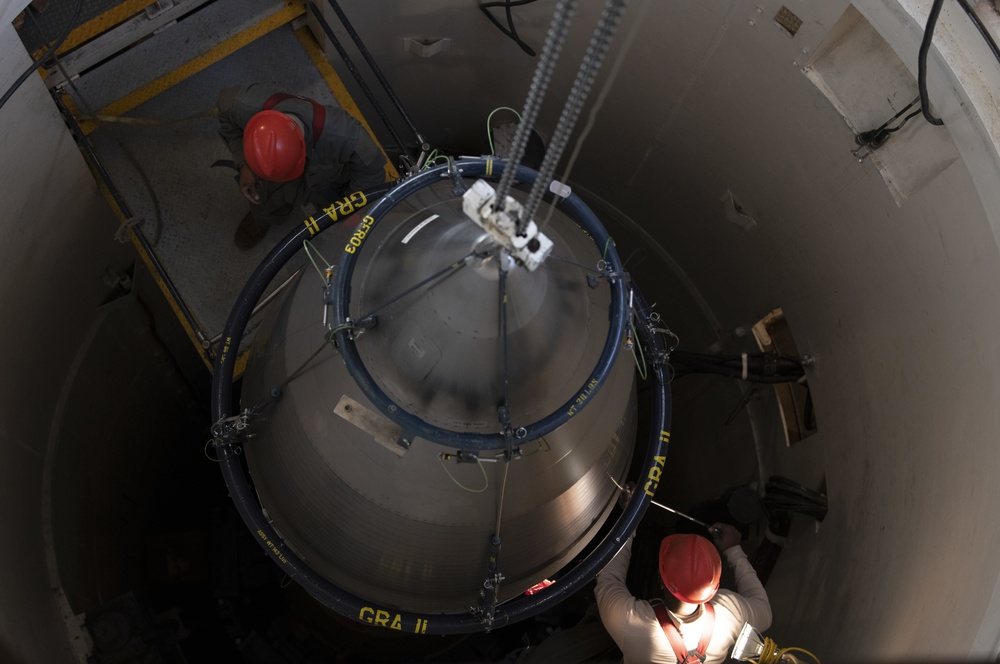
The U.S. Air Force is seeking industry input on an artificial-intelligence system intended to make technical and maintenance data for the Minuteman III intercontinental ballistic missile easier to find, compare and visualize.
The Air Force Nuclear Weapons Center issued a request for information describing an AI-powered data aggregation and visualization tool. According to the performance work statement, the Minuteman III Systems Directorate currently manages critical information across approximately 60 disparate and disconnected systems. Those systems include conventional databases, local hard drives and shared networks.
The request describes a sustainment problem rather than a new weapons-control function. Minuteman III data is spread across fleet-health metrics, engineering drawings, specifications, interface-control documents, supply records, maintenance systems, technical orders and risk repositories. Personnel must now devote substantial manual effort to compile those records and assess the condition of the weapon system.
The Air Force specifically identifies risks related to parts attrition and functional age-out. Maintaining a decades-old missile fleet requires tracking not only failures but also the availability of spares, the condition of components and the point at which older equipment may no longer meet functional requirements.
Under the concept, a contractor would design, develop, test and implement a software tool that gives users a single interface for querying connected sources. The system would also provide improved visualization of technical files, including 2D and 3D drawings and functional-flow diagrams. It is intended to complement, rather than replace, the existing AIMM3 fleet-health metrics tool.
The proposed system would not itself become the authoritative repository. The performance work statement requires it to draw from existing authoritative sources in near real time. The contractor would have to implement safeguards and continuous validation checks to ensure that the information presented matches the underlying data.
The Air Force has proposed quantifiable performance standards. The tool should connect to and query at least 95 percent of the initial set of specified data sources, while search results should be 99 percent accurate against source data. The program also expects a measurable reduction in the time and manual labor currently required to compile information.
Security controls are part of the requirement. The initial phase is expected to involve Controlled Unclassified Information at Impact Level 5. The statement says future efforts may include Secret data at Impact Level 6, which would require appropriate clearances for contractor personnel with access.
The RFI does not describe an AI role in launching Minuteman III missiles or replacing the command-and-control system. Its stated tasks center on data search, assessment and technical visualization for engineering, maintenance and supply functions. Separately, official Air Force information says Minuteman III launch control centers are staffed by two-officer missile combat crews and connected to national command authorities through a robust and redundant communications network.
The Air Force currently operates 400 Minuteman III missiles at F.E. Warren Air Force Base in Wyoming, Malmstrom Air Force Base in Montana and Minot Air Force Base in North Dakota. The missile was first deployed in 1970. The Air Force says ongoing component replacement and life-extension programs have kept the system in service while the LGM-35A Sentinel replacement is developed and introduced.
That age is central to the data challenge. The Air Force says much of the fundamental Minuteman infrastructure remains original equipment supporting more than 50 years of continuous operation. Every modification, replacement, maintenance action and supply decision adds another layer of records that must be understood alongside older information.
No contract has been awarded through this notice. The request for information is explicitly a market-research action, not a request for proposals or a commitment to funding. The Air Force is using it to identify potential industry capabilities and inform a possible future acquisition.
If the effort advances, its significance will lie in whether a modern AI interface can be made reliable enough for a sensitive sustainment environment without blurring the line between decision support and weapons command. In the current plan, that line remains explicit: AI may help people find the maintenance answer, but people and existing command systems remain responsible for the missile.
78