5 minBusiness
Musk's Flying Roadster Was a Pitch for a Tesla-SpaceX Merger, Analysts Say
Elon Musk's demonstration of a hovering Tesla Roadster built with SpaceX thrusters preceded the announcement that both companies' boards are forming special committees to study a merger. Analysts and legal experts question whether the synergies are real or a marketing exercise aimed at shareholders.
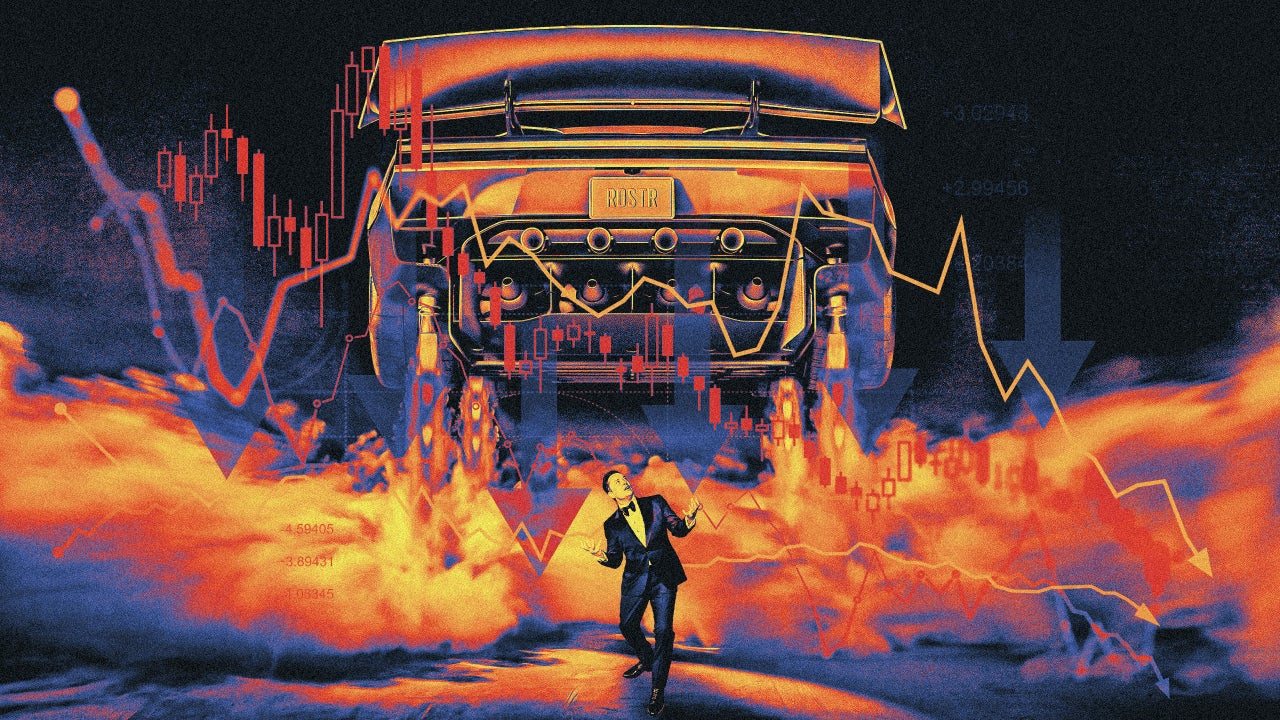
Elon Musk's demonstration of a Tesla Roadster that flipped and hovered using cold-gas thrusters built by SpaceX was less a product reveal than a marketing pitch for a merger between his two companies, according to analysts and corporate governance experts. Five days after the vehicle was shown last week, Musk announced on SpaceX's quarterly earnings call that the boards of Tesla and SpaceX are forming special committees to study a possible combination.
At the unveiling, Musk described the Roadster as «the culmination of incredible work by Tesla and SpaceX engineers working closely together.» But Ferdinand Dudenhöffer, director of the Center Automotive Research institute in Bochum, Germany, said the collaboration does not amount to meaningful synergy. He compared the concept to the flying cars promised in 1950s comics that were supposed to reach the market around 2000. «They remained utopias,» he said, calling the flying Roadster a technology story meant to lift Tesla's weak share price and the synergy claim «a modern marketing fairy tale.»
Any merger would require shareholder approval at both companies, and the hurdles differ sharply. Musk controls about 82% of the votes at SpaceX through super-voting shares, making approval there easier. At Tesla, where he owns about 20%, he would need to win over a large share of investors. On the earnings call, Musk described that as «quite a high hurdle.» Tesla's large base of small retail investors has historically shown low turnout in shareholder votes; the company won SEC approval last month for an «auto-vote» program aimed at addressing that.
Musk argued on the call that there is «a lot of merit to combining the companies, as we are pretty much in the superintelligence singularity.» Critics question how Tesla would contribute on that front. The carmaker has spent a decade promising artificial intelligence products that have yet to arrive at scale, and its Cybercab remains geofenced. By comparison, Google's Waymo operates robotaxis in 15 American cities and provides about 500,000 paid rides a week, while Baidu's Apollo Go had surpassed 22 million rides across 27 cities by April. BYD sells vehicles in China with Level 4 autonomous parking and covers damage they cause.
SpaceX already has artificial intelligence capabilities through SpaceXSI, and the two companies are already building Musk's proposed Terafab chip plant together. Tesla also sells Megapack batteries for SpaceX ground facilities such as server farms. Two companies run by the same person do not need a merger to cooperate, critics note; they need a purchase order. A more plausible synergy case once involved Optimus, Tesla's humanoid robot, which Musk said in March 2025 would travel to Mars aboard Starship. Neither arrived, and Musk acknowledged in January that the robot was «not in usage in our factories in a material way.»
On the governance side, Musk said each company has formed a special committee of independent directors to study the deal and that he cannot participate because he is a conflicted party. «It's an odd Kabuki dance where two groups of people are talking, and I can't be in the conversation,» he said. Ira Ehrenpreis sits on both boards, raising the possibility that he could end up on both sides of the negotiation. Brian Quinn, a Boston College law professor who studies mergers and acquisitions, said Tesla's special committee would have to prove no synergies to justify the deal. «Special committees are not required by the corporate law,» he said, adding that Musk could proceed without one if he chose.
Investors initially welcomed the prospect. Tesla's stock rose about 3% in early Wednesday trading, while SpaceX shares gained 9%. Whether the flying Roadster ultimately serves as a genuine engineering milestone or a shareholder persuasion tool, the episode has put the question of a Tesla-SpaceX combination squarely before investors who will eventually have to vote on it.
6