4 minWorld
Putin voices solidarity with Iran as experts warn Moscow and Tehran are bound by mutual need
Russian President Vladimir Putin met with Iranian President Masoud Pezeshkian at the Shanghai Cooperation Organization Summit in Kyrgyzstan, voicing full solidarity with Tehran. Experts say the growing partnership reflects mutual desperation, with Russia seeking Iranian missiles and Iran relying on Russian intelligence and support.
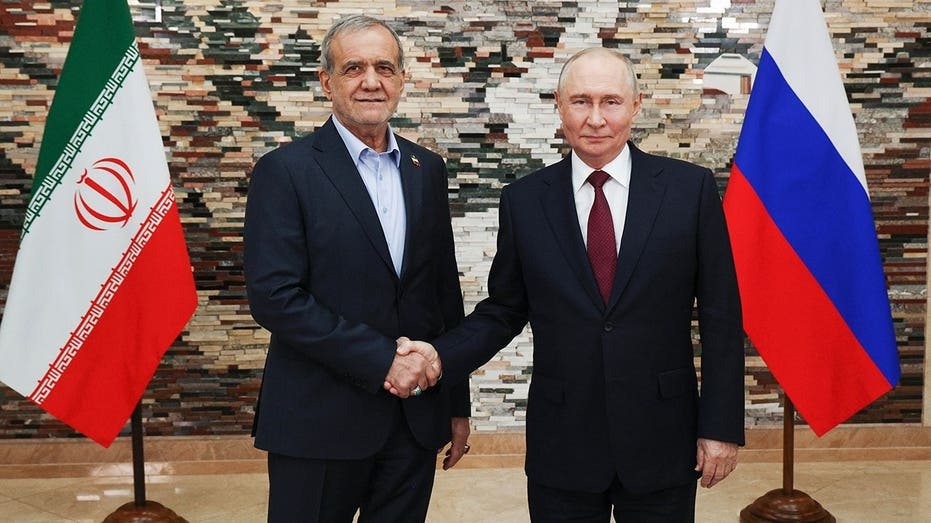
Russian President Vladimir Putin met with Iranian President Masoud Pezeshkian on the sidelines of the Shanghai Cooperation Organization Summit in Kyrgyzstan, where he voiced full solidarity with Tehran and praised Iran's leadership for its resilience in defending national interests. The Kremlin readout of Tuesday's meeting quotes Putin as saying, «Russia is standing in full solidarity with the people of Iran,» and adding, «We admire your courage and resilience in your fight for your national interests.» He also asked Pezeshkian to convey his regards to Supreme Leader Ali Khamenei.
The meeting underscores a deepening partnership between Moscow and Tehran, one that analysts say is driven less by shared ideology than by mutual necessity. Retired U.S. Air Force Gen. Philip Breedlove, a former NATO commander, told Fox News Digital that «this relationship between Iran and Russia is growing» and that «they both need each other desperately.» He described both nations as economically strained and reliant on one another for strategic survival: Russia needs Iranian missiles because Ukraine has targeted its own production capabilities, while Iran depends on Russian targeting intelligence to continue its operations against American forces in the Middle East.
Jason Brodsky, policy director of United Against Nuclear Iran, said the partnership has long been strategically important for both countries. «Russia views Iran as a cudgel to use against America, and Iran has in recent years especially viewed Russia as a lifeline with respect to advancing its military, providing economic support, providing political support, most importantly at the U.N. Security Council as Russia is a permanent member,» he said. Brodsky added that Russia is transferring technologies that help sustain Iran's leadership and its military capabilities.
Breedlove argued that the current U.S.-Iran conflict has evolved into «almost more a test of will than it is a military test.» He noted that the United States has established air and sea dominance, but because Washington has ruled out a ground invasion, Iran's Islamic Revolutionary Guard Corps believes it can survive the war. «All they have to do is survive and continue to threaten» the Strait of Hormuz, he said, warning that harassment of the strait would drive up maritime insurance rates and disrupt global shipping. «So we have a test of wills, a nation that can militarily end the war, should it make some more drastic decisions about how to get after the IRGC and a nation that understands it doesn't have to win, it just has to survive.»
Pezeshkian echoed Putin's warmth during the meeting, thanking Russia for its stance during the war and under U.S. sanctions. «Our relations are of a strategic nature. This is more than just 'normal' relations,» he said, according to the Kremlin. «We believe — no, we are certain that thanks to this we can stand up against U.S. bias and the rightless sanctions they are imposing on us.»
Brodsky said he sees no diplomatic resolution to the U.S.-Iran conflict while the current regime remains in power, describing it as «fundamentally anti-American to its core.» He pointed to President Trump's growing frustration with diplomacy as evidence that negotiations are unlikely to succeed. Breedlove, meanwhile, framed the Russia-Iran axis as part of a broader challenge to the Western order. He said Putin envisions a world divided into spheres of influence, with Russia dominating Western Asia and Europe, China controlling Eastern Asia, and the United States confined to the Western Hemisphere. «Mr. Putin is going to do nothing until someone shows him steel,» Breedlove said. «He understands power. Rhetoric doesn't do anything with Mr. Putin. Sanctions have never changed Mr. Putin's battlefield actions.»
68