5 minWorld
Admiral Paparo's Mission: Deterring War With China Over Taiwan
Admiral Samuel Paparo, head of U.S. Pacific Command, is tasked with preventing a Chinese invasion of Taiwan. His command oversees 400,000 personnel and 200 ships, and he emphasizes deterrence over combat.
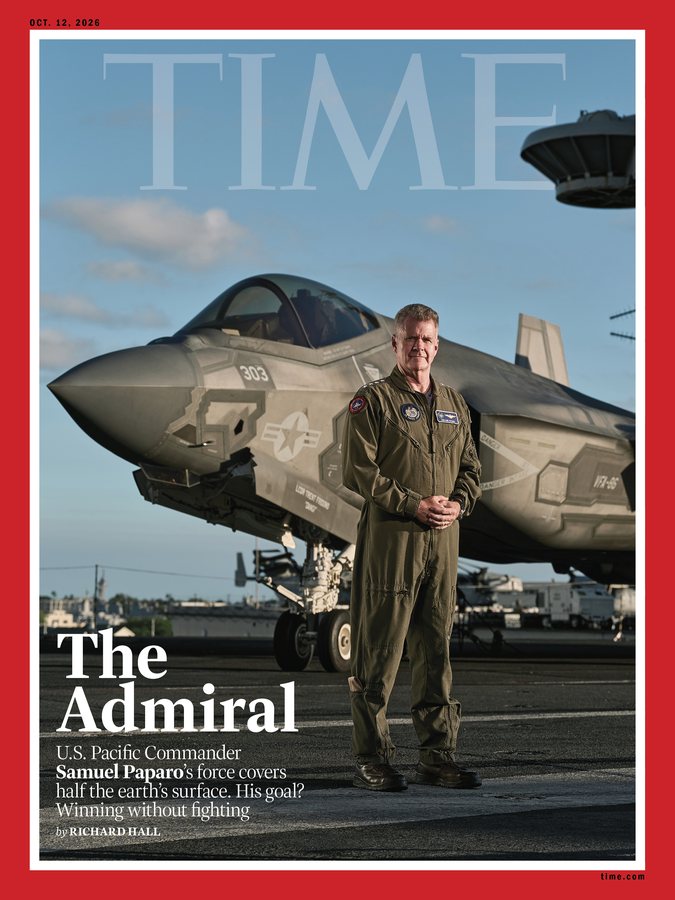
Admiral Samuel Paparo, commander of the U.S. Pacific Command, has a mission that few Americans will ever know about: preventing a war with China over Taiwan. In an exclusive interview with TIME, Paparo described his approach to deterrence, drawing on an unlikely source of inspiration—the character Iceman from the 1986 film Top Gun. «The hero of the movie is supposed to be Maverick, but the hero of the movie is actually Iceman,» Paparo said. «Maverick's got all the personal charisma, but Iceman is fastidious, quiet. He's the hard-working guy that does the right thing, that doesn't do flashy, dangerous stuff for its own sake.» That philosophy now guides Paparo as he leads the nation's oldest and largest geographic combatant command, which covers about half of the earth's surface and oversees some 400,000 military and civilian personnel, a Pacific Fleet of about 200 ships, including five aircraft carrier strike groups, and more than 1,000 aircraft.
Paparo's most critical mission is to deter a Chinese invasion of Taiwan, a self-ruling island that Beijing has vowed to bring under its control, by force if necessary. Chinese President Xi Jinping has called unification «a historical inevitability.» The admiral's job is to ensure that American power remains pre-eminent in the Pacific and that if conflict breaks out, the U.S. comes out on top. «I'm almost quoting Sun Tzu when I say winning without fighting is the acme of skill,» Paparo said. «Mission success for me is not to fight and win a war; it's to provide a deterrent capability so that we never go to war in the first place.» He added, «We don't seek to become great wartime leaders. We seek to be great peacetime deterrers.»
The challenge is growing. Over the past few decades, China has undergone a historic military buildup. According to the Center for Strategic and International Studies (CSIS), China's defense spending has increased 13-fold over the past three decades, and it now spends more on defense than the next 22 Indo-Pacific countries combined. China has made rapid advances in artificial intelligence and fielded several generations of fighter jets. Its navy has grown from a coastal force into one capable of projecting global power, and by hull count it is now the largest in the world. Brian Hart, deputy director of the China Power Project at CSIS, describes it as a «comprehensive, across-the-board modernization effort» that has changed the calculus for every power in the Pacific.
Paparo's command is designed to be the immovable object blocking China's expansionist ambitions. His role places him at an inflection point as American dominance in the Pacific faces its most serious challenge since World War II. The force he builds and the plans he puts in place last for decades and could determine to whom the next century belongs. «If I do my job right, history will never know my name,» Paparo said in his office at the U.S. Pacific Command headquarters in Hawaii, on a hill overlooking Pearl Harbor. The admiral, 61, speaks deliberately and in a low voice, smiling often. But when conversation turns serious, so does his expression—his brows furrow, and he stares into the middle distance to summon his words.
Paparo's mission remains constant regardless of which party or president is in the White House. As President Donald Trump prepares to meet with Xi for their third face-to-face summit since returning to office, the cameras are trained on the White House, and reporters will parse each utterance to divine whether the two powers are heading toward cooperation or conflict. It is Paparo's job to ensure that whatever happens when the leaders talk, U.S. power remains pre-eminent—and that if conflict breaks out in the future, it comes out on top. He must hold to that approach even as wars elsewhere consume munitions and resources he may need, and upheaval at the Pentagon raises the stakes of pushing back.
Paparo's career has precisely mirrored that of the fictional Iceman. He attended the Navy Fighter Weapons School, also known as TOPGUN, became a fighter pilot, then a four-star admiral, and eventually commanded the Pacific Fleet. He took the helm of the U.S. Pacific Command after passing the Navy's entrance exams in 1986, the same year he saw Top Gun. Few Americans will have heard of Admiral Paparo, and that suits him fine. His command oversees the often hidden and awesome infrastructure that backs up American military power, marshaling that power in distant oceans, islands, and military bases that most Americans will never see or even think about.
2