5 minSports
Battle to Protect Women’s Sports Continues After Supreme Court Ruling, Athletes Warn of Safety Risks
Despite a Supreme Court ruling on transgender athletes, 23 states still lack protective laws, and female athletes report ongoing competitive disadvantages, privacy violations, and sexual assault risks.
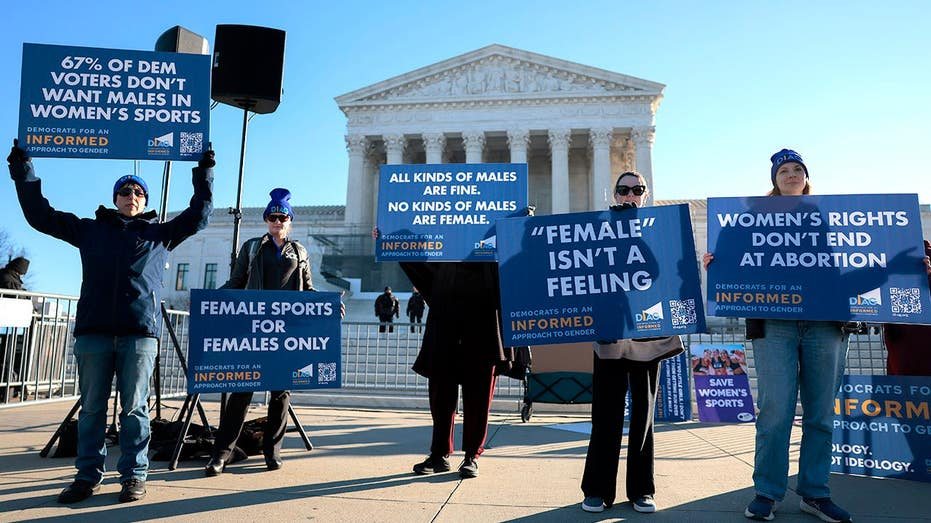
The Supreme Court’s recent ruling on transgender athletes has not resolved the ongoing debate over fairness and safety in women’s sports, leaving millions of female athletes in 23 states without legal protections. Among them is Washington state, where high school athlete Soleil Hoefer described the frustration of competing against biological males. “No matter what the ruling with the Supreme Court was, nothing has changed,” Hoefer told Fox News Digital. “It’s just really frustrating to be a part of such a movement that isn’t getting any relief.”
Hoefer recounted her own experiences, including a club soccer match during her junior year where she faced a biological male goalkeeper. “I was a forward. Wasn’t a great matchup,” she said. “Knowing that I didn’t have the physical ability to beat this man was so frustrating.” The following year, during a track event, she had to run the 400 meters against a male athlete. “The 400 meter race is already such a mental game,” she explained. “Knowing that no matter what I trained for and what time I ran, I would always lose was so frustrating.”
Beyond competitive inequities, Hoefer highlighted a more alarming issue: the risk of sexual assault. She referenced a case involving a Washington state wrestler named Kallie Keeler, who was allegedly sexually assaulted by a biological male transgender competitor during a match earlier this year. A lawsuit has been filed by Keeler’s family, and the case is being led by the Alliance Defending Freedom (ADF). Kristen Waggoner, CEO and president of ADF, called the incident “devastating” and “horrendous,” emphasizing that it is not an isolated event. “I wish it was an isolated case, but it’s not,” Waggoner said. “We will work until we win that case for her.”
Waggoner argued that the hidden damage of transgender inclusion policies extends beyond medals and scholarships to include privacy violations and physical safety. “Women and girls deserve their right to privacy and their right to physical safety,” she said. “You shouldn’t have to even have to talk about sexual assault as a consequence of this because we know that differences matter between the sexes.” She noted that girls have reported incidents in locker rooms, hotel rooms, bathrooms, and during contact sports when sex-based boundaries are removed.
Adaleia Cross, a West Virginia student-athlete, shared similar concerns after a transgender athlete at the center of a Supreme Court case competed on girls’ teams. Cross alleged sexual harassment and said her school district failed to protect her. The transgender athlete and their mother have denied the allegations, and the school district found them unsubstantiated, but Cross and ADF maintain that harm occurred. “Girls are not safe when they have to share private spaces with men, and people just don’t talk about it enough,” Cross said. “It’s really hard to think about even now to know how many other kids could they be doing that to?”
Hoefer echoed that frustration, calling for greater media attention to safety issues. “Us having to be in spaces with male athletes... having to share bathrooms, having to share locker rooms, having to share a hotel room if we're traveling, none of it is fair,” she said. “People always say ‘they're lying about it. People don't do that.’ But that's not what the reality is... people think it is all just about fairness, it's about safety.”
Madison Kenyon, a former Idaho State runner who was a voluntary defendant in the Idaho Supreme Court case, said mainstream media coverage has improved but still fails to center female athletes. “I think it should be bigger,” Kenyon told Fox News Digital. “I think that we should truly be showing the stories of the women.” She recalled that when she first entered the debate six years ago, “nobody was talking about it” and it was “taboo.” Now, she said, more Americans understand the stakes, but the fight is far from over.
As the legal and cultural battles continue, athletes and advocates are pressing for state-level action to protect women’s sports. With 19 states actively allowing biological males to compete in girls’ categories, the Supreme Court ruling has not changed the day-to-day reality for many female athletes. “When are people going to realize... it shouldn't have to come to this point where people are going through sexual assault or sexual harassment,” Hoefer asked. “I want the media to highlight that more.”

85