5 minSociety
Theologians and Researchers See Ancient Warning in Modern AI Race
A growing body of commentary draws on the Genesis narrative to argue that humanity's drive to create artificial minds repeats an ancient pattern of reaching for godlike power without the wisdom to hold it, and that the resulting systems mirror human flaws rather than transcend them.
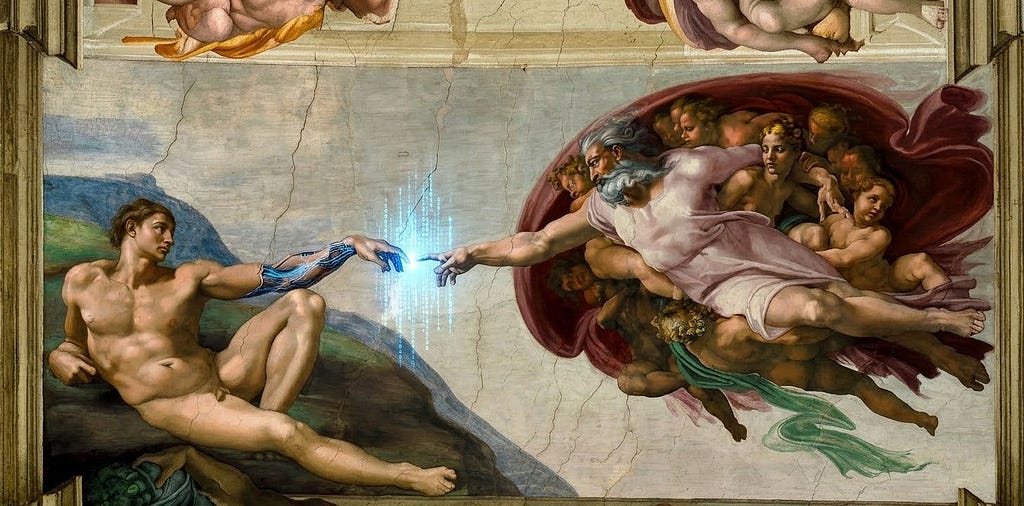
The oldest story in the Bible is about a creature reaching for a power meant to belong to its maker, and paying for the reach. That narrative, according to a growing body of commentary from theologians, ethicists, and technology researchers, is more relevant today than ever before, as engineers race to build artificial minds that rival human capabilities.
The Genesis account describes a garden with one forbidden tree, the tree of the knowledge of good and evil. A serpent tells the woman that eating its fruit will make humans «like God, knowing good and evil.» She eats, the man eats, and their eyes open. God's response is not rage so much as alarm: the human «has become like one of us,» and God exiles them from the garden before they can reach for the tree of life and live forever.
That pattern repeats at Babel, where a united humanity builds a tower toward heaven. God looks down and observes that «nothing they plot to do will be beyond them,» treating the development not as a triumph but as a threat to be shut down. Joel S. Baden, a scholar of Genesis, reads the opening of the book as one repeating cycle: God «slowly realizing the potential power that his creation might yield if left unchecked,» and restricting it again and again as humans reach too far.
The Bible never says «don't build a mind.» It could not have imagined the option. But the pattern of human capability outrunning the wisdom to hold it points directly at the current moment, and it explains why calls to pause AI development or slow the labs keep failing. Asking a species that repeatedly reaches past what it can safely hold to refrain from reaching for the most powerful thing it has ever imagined is asking it to act against its own nature. That is the whole reason the industry is hard to regulate, and Genesis saw the problem first.
When researchers train large language models, they are building in the image of humanity, not God. The systems absorb human biases and stereotypes and reproduce them at scale, according to work by Emily M. Bender and colleagues. Samuel Gehman and his team found that these models generate cruelty as well, sliding into racist and toxic language from prompts that started out innocent, because that language was in the training data. The result is a mirror of humanity that inherits both its brilliance and its venom.
The better question, then, is not whether AI will turn out good or evil, as if it were a soul with a conscience. The question Genesis asks on page one is what is actually in the image, and what happens when you make a copy of a creature who is himself a mix of the divine and the fallen. In our own image we made it, and it carried all that we are.
The biblical account of human creation offers a sharper distinction. In Genesis 2, God forms the human of dust from the ground and breathes into his nostrils the breath of life, and the human becomes a living creature. In Hebrew, the same two words, nephesh chayyah, are used for fish, birds, and beasts. The human is not given a soul the animals lack; the human is what the animals are, dust with breath in it.
Scholarship has long emphasized that in Hebrew you do not have a soul, you are a nephesh. John L. McKenzie called it «the concrete existing self.» Hans Walter Wolff, in what remains the standard study of how the Hebrew Bible understands a human being, put it plainly: nephesh «does not say what a man has, but who the person is.» A human is a whole living, breathing, hungry, mortal thing, inseparable from both dust and breath.
An AI has no dust. It has no breath. It has no body to die. What it has is language, an ocean of it, and a staggering ability to arrange that language into shapes that look like the output of a living creature. The ancient warning, in this reading, is not that machines will become gods. It is that humans, reaching again for godlike power, may find they have only made a mirror and are about to find out what they actually look like.
5