6 minSociety
Humanoid robots perform live gallbladder surgeries in world first
Researchers at UC San Diego successfully used teleoperated humanoid robots to perform gallbladder removal surgeries on pigs, marking the first time general-purpose humanoid machines have completed live operations.
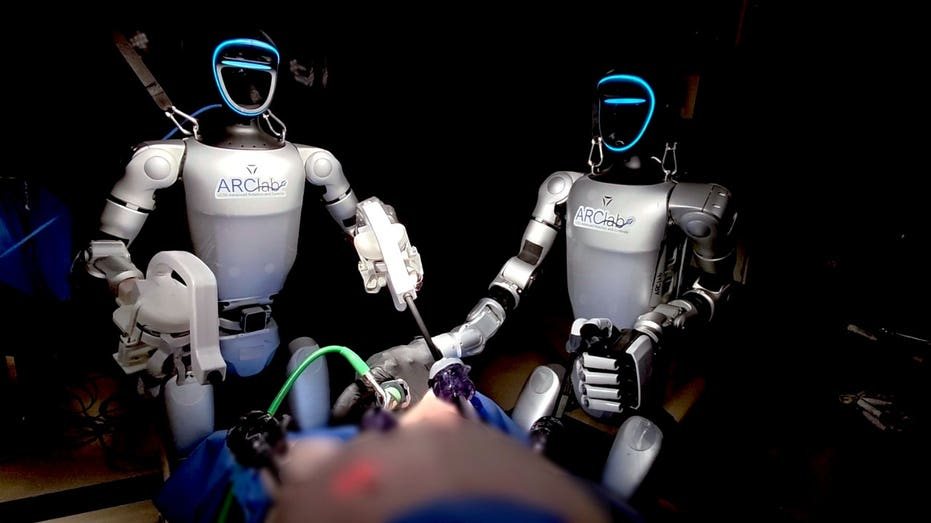
Humanoid robots have officially stepped into the operating room, completing two live gallbladder removal surgeries in a world-first preclinical trial. Researchers from the University of California San Diego reported the results in the journal Nature earlier this month, demonstrating that general-purpose humanoid machines can handle standard surgical tools with enough precision to perform delicate procedures.
During the experiment, surgeons remotely guided the robots through two laparoscopic gallbladder removal procedures on pigs. In one operation, a single humanoid robot handled surgical instruments while a human surgeon assisted beside it. In the second procedure, two humanoid robots stood side by side and worked as a team, both controlled remotely by surgeons. The robots copied the surgeons' movements rather than making medical decisions, and no human patients were involved.
The trial involved tasks typical of minimally invasive gallbladder surgery: moving tissue, dissecting around the gallbladder, and placing clips before removing the organ. The researchers designed the experiment as a proof of concept to determine whether a general-purpose humanoid robot could handle standard surgical instruments with enough control to complete an operation. It could, though the trial also revealed challenges that must be solved before testing on humans.
The machines used in the study, named Surgie, are modified versions of commercially available Unitree G1 humanoid robots. Each robot stands about five feet tall and weighs roughly 60 pounds, making them dramatically smaller than many existing robotic surgery systems, which can weigh around 1,800 pounds. Large surgical robots often require extensive setup and dedicated space, sometimes forcing hospitals to retrofit an operating room before installation. Surgie, by contrast, can operate in a room designed for human medical workers.
Researchers added adapters to the robots' hands so they could grip standard laparoscopic instruments. A surgeon then controlled the robot from a remote console. When the surgeon moved the controls, Surgie copied those movements at the operating table. That human-like design is important because it means a hospital may be able to bring the robot into an existing room instead of rebuilding the space around it. A medical team could also move the robot between rooms or transport it to a smaller facility.
«We were surprised at how well Surgie meshed with our workspace and workflow,» said Nikita Thareja, MD, a general surgery resident at UC San Diego School of Medicine and a co-author of the study.
The base Unitree G1 robot is listed at $13,500 before taxes and shipping, though that price does not include the surgical adapters, instruments, or remote-control equipment used in the study. The price still points to a potentially significant cost difference compared with today's specialized surgical systems. Da Vinci surgical robots, for example, can cost from about $700,000 to more than $3 million, depending on the model and configuration. Researchers have not disclosed the total cost of the complete Surgie setup.
Modern robotic surgery systems already help doctors perform highly precise procedures, but those machines usually stay in one location and depend on specialized equipment. A humanoid robot offers more flexibility because it can operate in spaces built for medical workers and can hold tools designed for human hands. Researchers believe future versions could retrieve an instrument during surgery, help prepare or clean the room after a procedure, and, most importantly, bring a specialist's skills to areas where surgeons are difficult to find.
Michael Yip, a professor in UC San Diego's Department of Electrical and Computer Engineering, said remotely operated humanoids could expand access to critical procedures. Researchers envision sending the robots to communities with limited medical staffing or temporary field hospitals. The goal is not to hand medical decisions to a machine; a trained surgeon would remain in control while the robot carried out those movements at the patient's location. That could give a trauma team on a battlefield access to a specialist located elsewhere, or allow a rural clinic to offer surgical care that would otherwise require a long-distance transfer.
The trial builds on UC San Diego's earlier research with the same type of robot, which previously performed seven medical procedures including physical exams and ultrasound-guided injections. The latest results represent a significant step forward, but researchers caution that several hurdles remain before the technology can be tested on human patients. These include improving the robot's dexterity, ensuring reliable communication between the surgeon and the machine, and addressing safety concerns. The study offers an early look at how a specialist could someday operate through a mobile robot in a rural clinic or another place where surgical care is hard to reach.
81