6 minPolitics
Trump's America.gov AI Chatbot Launches, Experts Say It's a Glorified Search Engine
President Trump signed an executive order launching America.gov, an AI chatbot designed to simplify access to federal services. Experts praise its privacy protections but warn it doesn't fix underlying government inefficiencies.
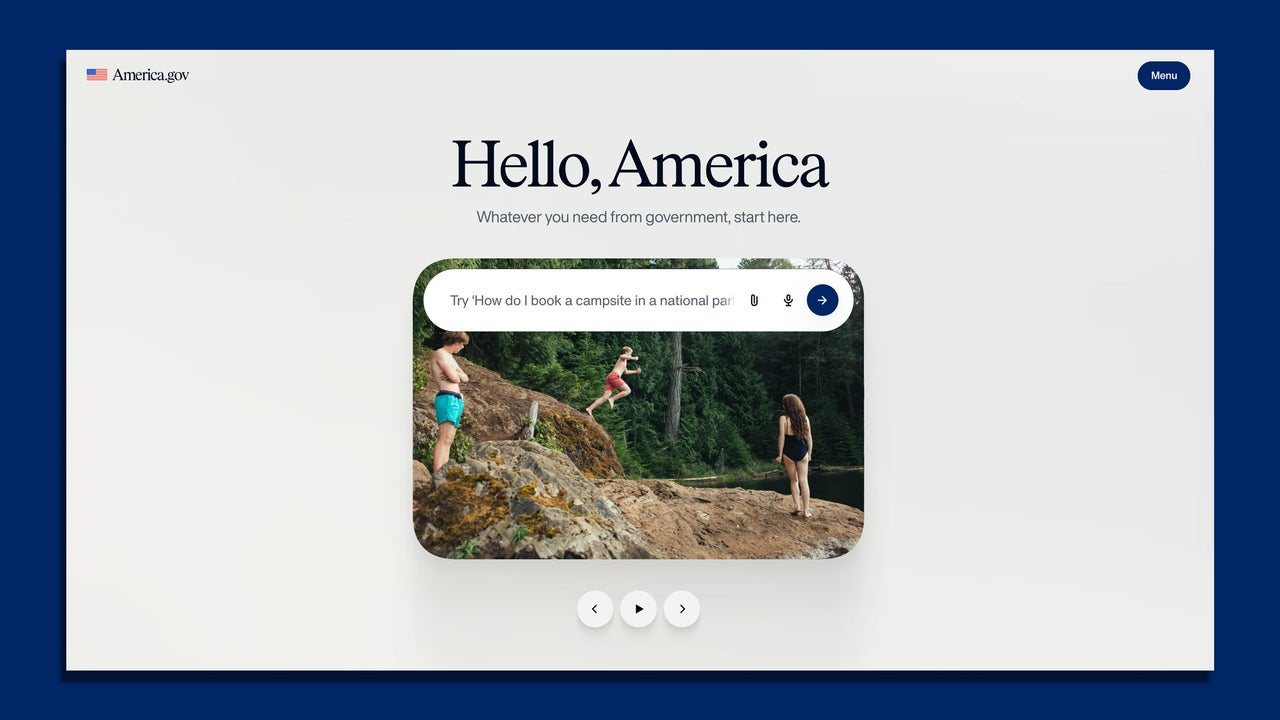
President Donald Trump signed an executive order on September 29 launching America.gov, a new AI-powered chatbot intended to serve as a single front door for Americans navigating federal services. The tool, which uses Gemini and Grok as its underlying models, is designed to answer questions about government programs by searching official sources and providing citations. At the signing ceremony, Trump framed the effort as both a practical and symbolic upgrade. «We're simplifying it. We're glamorizing it,» he said. «We're making it what it should be.»
The chatbot arrives amid widespread public adoption of AI tools—roughly half of Americans report using a chatbot, according to the Pew Research Center—and an ongoing frustration with the complexity of federal bureaucracy. America.gov requires no account, does not store chats, and collects what experts describe as a surprisingly small amount of user data. It relies on an open-source classifier system called Rampart to strip personally identifiable information from queries and attachments.
Privacy experts who tested the system found meaningful safeguards. Calli Schroeder, senior counsel and director of the AI and Human Rights Program at the Electronic Privacy Information Center, attempted to break the chatbot by asking about vaccines, immigration, and voter registration—all politically sensitive topics—and by submitting a fabricated Social Security number. The system blocked the Social Security number and repeatedly declined to offer legal advice. «That's great,» Schroeder said. «That's a really good built-in protection.» She noted, however, that other made-up personal details, including a name and address, were not always stripped.
The privacy-by-design approach matters because users often share sensitive information even when warned not to. Merici Vinton, a senior fellow at the Center for American Progress who previously helped build the IRS's Direct File tax service, recalled that users of that program's human chat service routinely provided names and Social Security numbers despite explicit instructions not to. «There should be no savviness» required to interact safely with government, she said.
On usefulness, early reviews are cautiously positive. Noah Giansiracusa, an associate professor of mathematical sciences at Bentley University and a faculty associate at Harvard University, said he expected to be critical but found the tool thoughtfully executed. Restricting the chatbot to government information gives it an edge over general-purpose AI models when answering questions about taxes or Medicare, he said. «Basically this use of a chatbot is like a search function on steroids,» Giansiracusa said, noting that it can interpret a question and pull together an answer from relevant government websites rather than simply matching keywords.
Yet experts stress that America.gov adds a new interaction layer on top of existing government data without changing how citizens actually complete tasks or interact with agencies. «It is a cool new chatbot,» Vinton said. «But fundamentally, I don't get the sense that any of the underlying services or access to those services or access to that data has changed.» The tool does not alter how Americans file taxes or apply for federal student aid, for instance. «Really it's just linking to them,» she said. «It's something, but it's not a radical reinvention.»
Dana Chisnell, a longtime government service design expert and former executive director for customer experience at the Department of Homeland Security, offered a similar assessment. She called the chatbot «a glorified search engine» right now—«which is not a bad thing.» For someone who has just survived a disaster, being able to describe what happened and immediately find relevant federal help could be genuinely useful. But she cautioned that «making a fresh front door does not change the underlying challenges with helping average residents get services they are eligible for.»
Trustworthiness also remains an open question. Because the chatbot draws only from government websites, its answers are only as reliable as those sources, which can be incomplete or out of date. «It's only as good as the information that's on the government websites,» Schroeder said. Within hours of launch, the Associated Press found that America.gov initially answered several politically sensitive questions—including about the 2020 election and climate change—before subsequently refusing to answer some of the same questions.
More fundamentally, some experts question whether a chatbot is the right solution. «I've never met a user who says, 'I want a government chatbot,'» Vinton said. «What people say is 'I want this application to be simpler. I want this response from the...'» The comment reflects a broader concern that the new interface, however polished, may not address the structural problems that make government services difficult to access in the first place.
5