6 minPolitics
Trump Announces 'AI Force' and Plans to Name AI Czar
President Donald Trump said he is creating an 'AI Force' and will soon appoint an artificial intelligence czar, vowing to protect the industry from regulation while using existing laws to address wrongdoing.
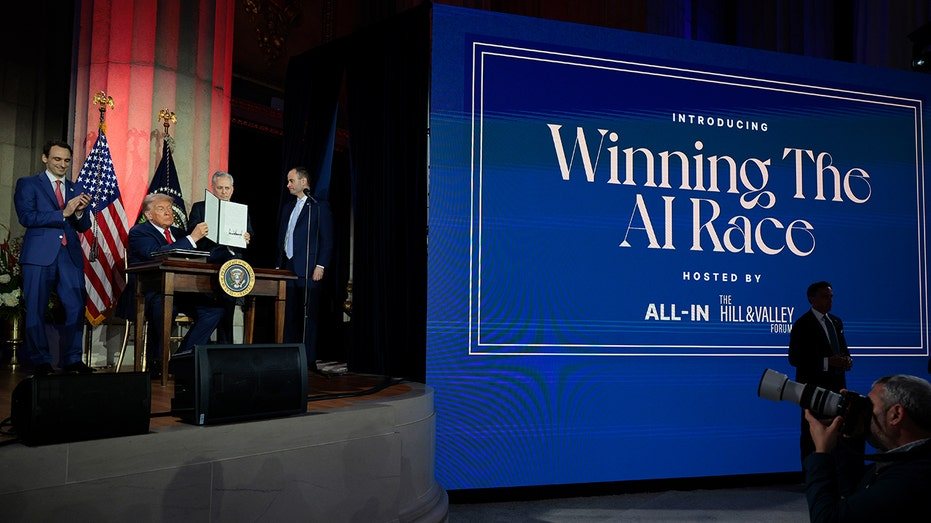
President Donald Trump announced the creation of an «AI Force» and said he will soon name an artificial intelligence czar, signaling that his administration will actively promote the technology while resisting new restrictions on it.
In a lengthy post on Truth Social, Trump said his administration would not «in any way hinder or stifle the Growth of this incredible Industry.» He added that the government would «cherish it, help it, and watch over it, as it grows.»
The president said the new entity would be modeled on the Space Force, which he established during his first term and described as a «tremendous SUCCESS.» He did not provide details about the structure, authority or membership of the proposed AI Force, nor did he identify any candidates for the czar position. «Only High I.Q. individuals need apply!» he wrote.
Trump also said his administration would be «looking for BAD» and indicated that existing criminal and civil laws could be used to address problems involving artificial intelligence. The announcement comes as lawmakers continue to debate whether and how to regulate the rapidly developing technology.
Some Republicans have questioned calls for additional government oversight, while others have pushed for safeguards after AI industry leaders raised concerns about increasingly capable models. Earlier in the week, Trump rejected calls for new regulation, arguing that restrictions could hinder the United States in its competition with China.
In his Saturday post, Trump compared criticism of AI and data centers to other political controversies and argued that opposition to data-center construction had largely failed. He predicted that AI could eventually account for as much as 25% of U.S. gross domestic product, though he did not cite a source for the estimate.
«AI is the next Industrial Revolution, or Internet, but will be even larger and more impactful, possibly as much as 25% of our Country’s GDP,» he wrote. «We are leading China, and the rest of the World, and I intend to keep it that way!»
In a separate Truth Social post, Trump asked followers to vote on what to call artificial intelligence. «Many people think that the words 'Artificial Intelligence' are inaccurate, and very ineloquent, relative to AI, or Artificial Intelligence,» he wrote. «A far more elegant and accurate description of this new phenomena would be Superior Intelligence (SI) or, Extreme Intelligence (EI) or, Supreme Intelligence (SI).» He described the post as a poll and encouraged participation.
The announcement adds to a broader debate in Washington over AI policy. Lawmakers have grappled with proposals ranging from safety standards to a possible «kill switch» for advanced models, while industry groups have warned that heavy-handed rules could slow innovation. Trump’s approach appears to favor minimal regulation and rapid development, with the justice system serving as a backstop for misuse.
It remains unclear how the AI Force would operate, what budget it would receive or how it would coordinate with existing agencies. The White House has not released further details. Trump said the czar announcement would come «in the near future,» but gave no timeline.
The president’s comments also touched on the growing energy demands of AI data centers, which have become a flashpoint in local communities. He argued that opposition to such facilities had largely failed and framed the technology as a national priority.
Trump’s estimate that AI could reach a quarter of U.S. GDP is far above most independent forecasts, which typically project the technology’s direct contribution as a smaller share of economic output over the next decade. The White House did not provide supporting data for the figure.
For now, the proposal raises questions about how the administration would balance its stated goal of protecting the industry with its pledge to use existing laws against wrongdoing. Trump’s post suggested both would proceed simultaneously, with the government acting as a promoter and a watchdog.
The announcement is likely to intensify lobbying from technology companies and civil-society groups as they seek to shape the emerging policy landscape. Congressional committees have already held hearings on AI risks, and more are expected.
Trump’s decision to solicit public input on renaming AI also underscores his preference for direct communication with supporters. The poll, conducted informally on Truth Social, has no binding effect but drew immediate attention.
Whether the AI Force becomes a formal agency or a coordinating body remains to be seen. For now, the president’s message is clear: his administration intends to move quickly on AI and to resist what he views as unnecessary obstacles.