5 minPolitics
South Africa’s Anti-Immigration Protests Escalate as Government Faces Pressure
Thousands of South Africans have taken to the streets demanding that illegal immigrants leave, mirroring political battles over migration in Western nations. The government faces growing pressure to tighten border controls amid accusations of rampant crime, job displacement, and overwhelmed public services.
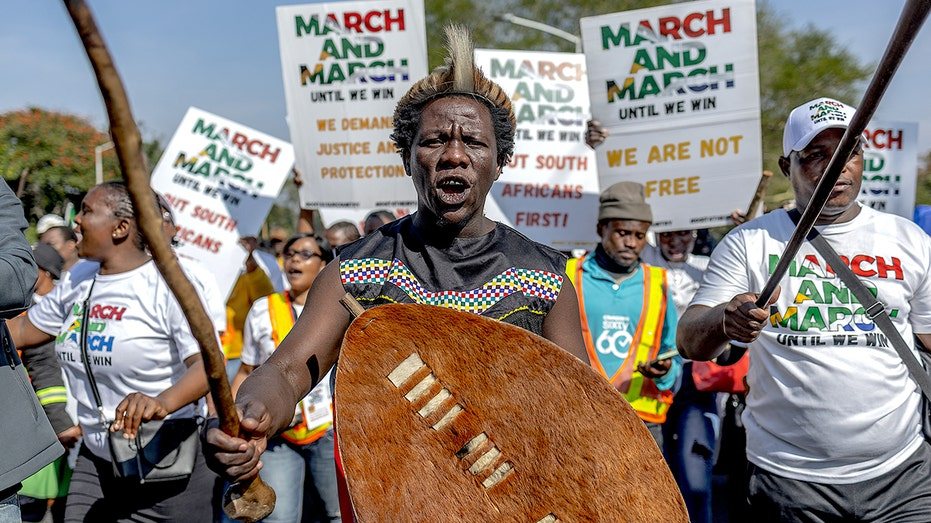
South Africa is experiencing a dramatic surge in anti-immigrant sentiment, with thousands of citizens taking to the streets to demand the departure of illegal foreign nationals. The protests, which have led to the departure of over 160,000 undocumented immigrants, reflect a growing backlash against government inaction on border security and migration management—a pattern increasingly seen across Western nations.
The marches, organized primarily by the March and March movement, have drawn large crowds wielding traditional knobkerries, or large wooden sticks, as a symbol of authority. Founder and leader Jacinta Ngobese-Zuma told reporters that the country has had enough and claimed that between 15 and 30 million undocumented immigrants are living in South Africa, a figure that dwarfs the official census estimate of about 3 million. The government’s statistics body, Statistics SA, has acknowledged difficulties in verifying immigration data, with its head admitting that officials often rely on self-reported information due to a lack of verification mechanisms.
Violence has accompanied some protests. In early July, police arrested 900 people during a nationwide day of demonstrations, and at least one death has been reported near Johannesburg. Up to five immigrants have been killed by protesters so far this year, though the March and March movement says it opposes violence. In areas such as Soweto, groups have gone door-to-door giving ultimatums for foreigners to leave the country.
The economic dimension of the crisis is significant. South Africa’s official unemployment rate stands at 32.7%, one of the highest in the world. Yet many illegal immigrants have found work, often under exploitative conditions. President Cyril Ramaphosa acknowledged in a televised address that some employers hire undocumented workers to pay wages well below the minimum wage and impose longer hours without compensation. Activists argue that this practice deprives South African citizens of jobs and undermines labor standards.
Public services are also under strain. At a Johannesburg government hospital, patients have reported waiting up to 36 hours in the emergency room due to the influx of foreign nationals seeking free or subsidized care. At least one patient died while waiting at Helen Joseph Hospital, a facility built to serve citizens. Ngobese-Zuma pointed out that taxpayers fund the health and education systems, which are being exploited by people who believe the services are free.
Border controls have been widely criticized as ineffective. Reports indicate that hundreds of thousands of people enter South Africa simply by wading across low rivers, with crocodiles posing more danger than border officials. Corruption and bribery at border posts are described as endemic. The government has responded to public outcry by vowing to crack down on immigration, with President Ramaphosa announcing measures to tighten enforcement. As of July 11, authorities reported that 53,449 foreign nationals had been processed for deportation and repatriation—a small fraction of the estimated illegal population.
The political timing is important. Local elections are approaching, and the African National Congress government, already under fire for economic woes and service delivery failures, faces growing pressure from opposition figures such as Herman Mashaba, who have called for more aggressive action. The protests in South Africa echo similar movements in Europe and the United States, where migration has become a central political battleground. Observers note that the dynamics—limited state capacity, public anger over crime and jobs, and perceptions of uncontrolled borders—are strikingly similar.
Ngobese-Zuma and her movement insist that their goal is not violence but a return to order. They demand that the government prioritize South African citizens in employment, healthcare, and education. With the country’s census data contested and enforcement mechanisms weak, the standoff between activists and the government shows no signs of resolution. Meanwhile, buses and repatriation flights continue to carry undocumented immigrants back to their home countries, including Ghana, where border officials recently found 321 of 332 passengers traveling without valid documentation.
76