5 minPolitics
Putin’s visibility has become an election asset for the Kremlin
A Pladrom investigation contrasts Vladimir Putin’s past public absences with a burst of regional travel and party appearances ahead of Russia’s September parliamentary vote.
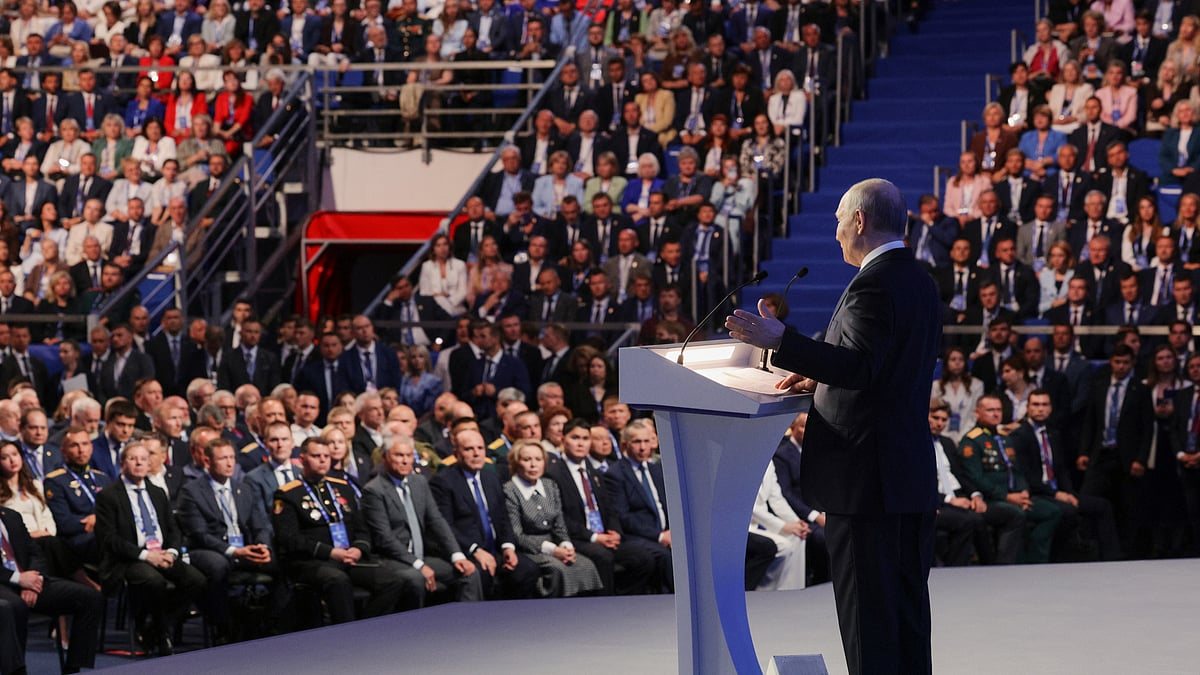
Vladimir Putin is spending the final stretch before Russia’s parliamentary election doing something that has not always been necessary for his political system: being visibly present. He appeared personally at United Russia’s federal campaign congress, traveled to an aircraft plant in Irkutsk, and then made a rare trip to Krasnoyarsk for meetings with regional officials and young people.
A new exclusive investigation by Pladrom argues that the contrast matters. In earlier periods, Putin could disappear from verifiable public events for days without creating an immediate political crisis. In March 2015, he was absent from public view for roughly ten days as meetings were canceled or postponed and the Kremlin offered only limited explanations.
The incentives are different in 2026. State Duma elections are scheduled for September 20, and United Russia is explicitly tying its campaign to the president. A leaked description of the party’s campaign brand book lists “United Russia — the president’s team” among its central messages. That makes Putin’s personal image part of the party’s electoral product even though he is not running for a parliamentary seat.
On June 28, Putin spoke at United Russia’s 23rd congress as the party launched its federal campaign and nominated candidates. On July 24, he traveled to Irkutsk and toured production of the MC-21 passenger aircraft. On August 3, he appeared in Krasnoyarsk, where he met the governor and took part in a public youth event.
Each stop provides several political images at once: an active head of state, a federal center paying attention to the regions, and a president personally associated with industry, infrastructure and younger voters. In a highly personalized system, physical presence can carry more symbolic weight than a detailed party platform.
The timing also coincides with a less comfortable public mood. Levada Center put approval of Putin’s performance at 80 percent in March. That remains high, but it was seven percentage points lower than in September 2025. The direction of movement, rather than the absolute number, is likely what matters most to officials accustomed to presenting political support as stable and overwhelming.
Economic sentiment is another pressure point. Levada’s consumer sentiment index fell to 94 in June, its first reading below 100 since October 2022. Thirty-five percent of respondents said their material situation had worsened over the previous year. Those figures do not directly predict voting, but they make it harder for a campaign to rely on abstract claims of stability.
Putin’s regional appearances help bridge that gap. A factory visit can be framed as evidence of industrial resilience. A meeting with a governor becomes proof that local problems reach the top. A youth event produces images of energy and continuity. The format is especially useful in a political environment where institutions are weaker than the presidency itself.
It would go too far to claim that this proves Putin personally fears losing power. There is no reliable evidence of his private psychological state, and the electoral field remains heavily restricted. On August 10, Russia’s Supreme Court barred the anti-war Yabloko party from the parliamentary election, further narrowing meaningful competition.
The more plausible risk for the Kremlin is not an outright electoral defeat but an unconvincing display of control: lower turnout, weaker-than-expected results in some regions, or a visible mismatch between official confidence and public frustration. In that context, presidential visibility becomes a form of political insurance.
United Russia’s decision to campaign as “the president’s team” deepens that dependence. The stronger the party links itself to Putin, the more damaging a prolonged absence could become during the campaign. What was once a source of rumor can now become a strategic communications problem.
Between now and September 20, the frequency and geography of Putin’s appearances will therefore be worth watching. If the current pace continues, it will reinforce a broader conclusion: in Russia’s personalized political system, the president’s physical visibility has become a campaign resource in its own right.
60