5 minPolitics
Judge Boasberg draws scrutiny as he oversees Ilhan Omar warrant case
Chief Judge James Boasberg, who has clashed with the Trump administration, is presiding over the media challenge to unseal the search warrant for Rep. Ilhan Omar's home, raising questions about how cases are assigned.
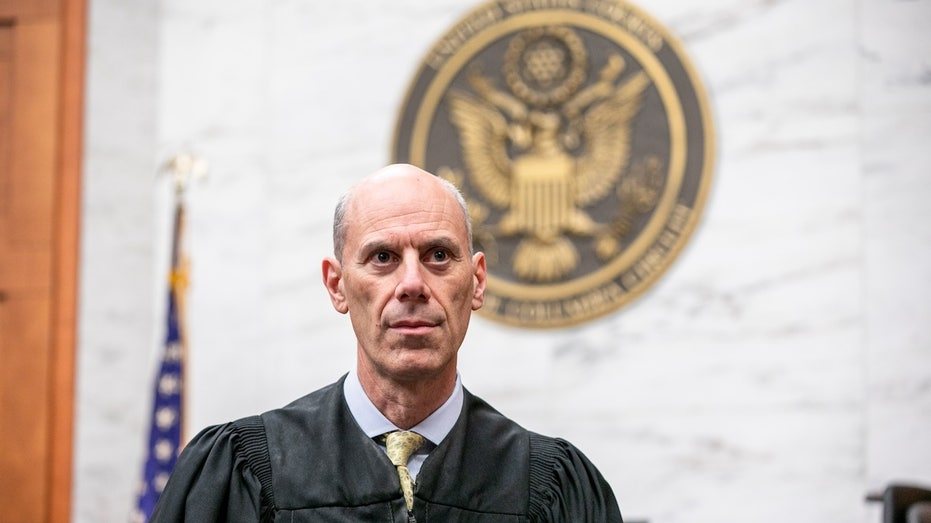
Federal Judge James Boasberg, a chief judge of the District of Columbia federal court whom President Donald Trump has called a "Radical left lunatic," is overseeing a challenge by several media outlets seeking to force the Justice Department to unseal the search warrant for the home of Rep. Ilhan Omar, D-Minn. The assignment has renewed questions about how judges are chosen for high-profile cases involving the Trump administration.
The warrant stems from two federal investigations. Boasberg, an appointee of President Barack Obama, presides over the district court's chief judgeship, which gives him authority over certain matters. Critics on social media seized on his involvement, with Steve Ferguson, a self-described business owner with more than 250,000 followers on X, writing, "Is everything rigged?"
Under the court's rules, cases in the District of Columbia federal court are assigned to judges randomly through an electronic system managed by the clerk's office under the direction of the Calendar and Case Management Committee. The committee consists of three to five judges appointed by the chief justice. There are exceptions. Criminal grand jury matters are assigned to and overseen by the chief judge, which is why Boasberg's role in the Omar warrant fight was, as Iowa Solicitor General Eric Wessan put it, "not a surprise."
Wessan nonetheless said the pattern of assignments raises concerns. "There are a lot of cases that seem to be going to judges maybe based on those cases having similarities which is not what the local rules say," he told Fox News Digital. He added, "If one is just following anecdotally, there does seem to be a lot of high-profile cases in front of judges that seem to be expressing unusual amounts of frustration or disagreement with the administration," and urged greater transparency in how assignments are made.
Boasberg is also handling other significant disputes involving the administration. He is overseeing California's lawsuit over voter-roll disputes, and on a Friday he ordered the administration to provide the state with the names and supporting information for roughly 20,000 people whom the Justice Department claims are noncitizens on California's voter rolls, by the end of that day.
His earlier rulings have drawn sharp responses from the administration. In March 2025 he ordered the government to turn around deportation flights carrying alleged Venezuelan gang members bound for El Salvador. The administration cited the Alien Enemies Act as legal justification for the removals. The Supreme Court later vacated Boasberg's temporary restraining order blocking the flights, ruling that the case had been brought in the wrong jurisdiction.
The same month, Boasberg was assigned a lawsuit seeking to preserve Signal messages after senior administration officials discussed plans for a Yemen strike in a group chat that accidentally included Atlantic editor-in-chief Jeffrey Goldberg. He later ordered the administration to preserve the messages.
The string of cases prompted Reps. Jim Jordan, R-Ohio, Darrell Issa, R-Calif., and Chip Roy, R-Texas, to write to the court clerk in May 2025 asking for greater clarity on judicial assignments. They said the committee could not independently verify the randomness of assignments because the composition of assignment decks is kept secret, and said they needed to understand the process to consider appropriate legislation.
In July, Sen. Eric Schmitt, R-Mo., introduced legislation that would require federal district courts to assign cases randomly without exceptions. He named it the Boasberg Act, and the bill is currently stalled in committee. "Judge Boasberg is the poster child for a rogue judge and exposed serious loopholes in our judicial system," Schmitt said in a statement. "Randomly assigning cases among judges ensures the American people can have confidence in the impartiality of our courts."
Under the D.C. court's rules, the chief justice does not have the power to reassign a case; the Calendar and Case Management Committee handles reassignments. The court must notify the judges and attorneys involved but does not have to publicly explain why a case was moved. Wessan said the rules should be clearer. "The rules shouldn't say one thing if it's not true. But if it is true, they could just say so. I think the issue is with the exceptions—what happens in those exceptional cases and how often do they occur?" he said.
6