5 minPolitics
Democrats Hold Slim House Lead in Fox News Power Rankings, Redistricting Keeps GOP Competitive
Fox News Power Rankings show Democrats with a narrow lead in the House, but Republican redistricting gains, especially in Florida and Texas, keep the GOP within striking distance for the 2026 midterms.
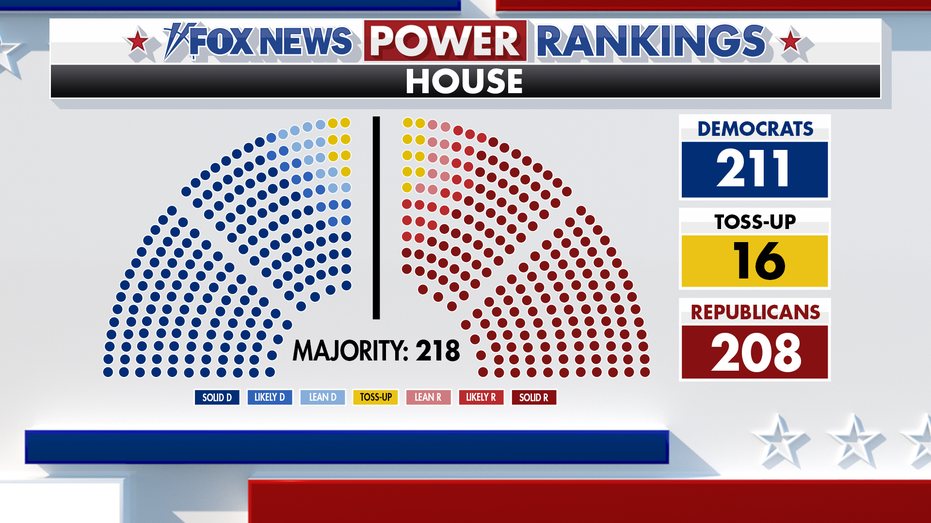
Democrats hold a slim lead in the race for control of the U.S. House of Representatives, according to the latest Fox News Power Rankings, but Republican advantages from redistricting are keeping the GOP competitive in what is shaping up to be a closely contested midterm election. The analysis shows Democrats starting with 211 seats in their favor, seven short of the 218 needed for a majority, while Republicans have enough room to maintain control on a strong night for the party.
The president's party has historically lost an average of 25 House seats in midterm elections during the Trump era, and Democrats currently hold an edge on the generic ballot and in party affiliation. However, Republican redistricting wins have altered the political landscape. The GOP is expected to gain about a dozen seats from new district boundaries drawn by Republican-controlled state legislatures, with up to nine of those coming from Florida and Texas alone. Democratic Governor Gavin Newsom secured an additional three to five seats for his party after voters approved a gerrymandering referendum in California, but overall, Republicans have won the redistricting battle in what analysts describe as a "forever war" over district lines.
Five key districts are highlighted as critical battlegrounds. New York's 17th district, in the Hudson Valley, is considered the quintessential median district, having voted for Republican Mike Lawler in 2024 while also supporting former Vice President Kamala Harris by a narrow margin. Democrat Cait Conley, a moderate and combat veteran, is challenging Lawler with a center-left, anti-Trump platform and strong fundraising. The race is rated as Lean Democratic.
In Pennsylvania, the seventh district is a toss-up featuring Republican Representative Ryan Mackenzie, who flipped the seat in 2024, and Democrat Bob Brooks, a firefighter endorsed by both Governor Josh Shapiro and Senator Bernie Sanders. The race tests whether a Democrat who unifies the party's wings can appeal to working-class voters who have shifted toward the GOP. Pennsylvania has four highly competitive districts, tied with California for the most in the nation.
North Carolina's first district was redrawn by Republicans to reduce the number of Black voters, making it more favorable for the GOP. Incumbent Democrat Don Davis, whose home was moved to another district, is running against Republican Laurie Buckhout, a retired Army Colonel and Trump supporter. Both candidates raised $1 million in the last quarter, and the race is rated a toss-up, though Republicans could flip it on a good night.
Alabama's second district is currently held by Democrat Shomari Figures, who flipped the seat after a federal court ordered a map with a higher Black population. However, after the Supreme Court narrowed a key provision of the Voting Rights Act in April, Governor Kay Ivey restored the original map, making White voters nearly two-thirds of the district. Figures faces Trump-endorsed state Representative Rhett Marques, and the race is rated as Likely Republican pickup.
In Florida, Governor Ron DeSantis's new map could yield up to four additional Republican seats, but the outcome depends on the overall national environment. As noted by the Wall Street Journal, making a blue district more Republican often means making a red one less Republican, creating a delicate balance. The 26th district remains Solid Republican, but the 14th district is a Democratic-held seat with more GOP-leaning voters, though not enough to guarantee a flip.
Beyond redistricting, factors such as candidate quality, ground game, and the top of the ticket in each state remain important. The Fox News Power Rankings suggest that while Democrats have a slight advantage, the race is far from decided, and Republicans could improve on their slim majority if they win a majority of toss-up races. The midterm elections are expected to be highly competitive, with control of the House hanging in the balance.
71