5 minPolitics
Democrat Mary Peltola wins Alaska Senate race, flipping a GOP seat
Democrat Mary Peltola has defeated Republican incumbent Dan Sullivan in Alaska's U.S. Senate race, a result that flips a seat in a state Donald Trump carried in 2024 and gives Democrats a 56-44 Senate majority.
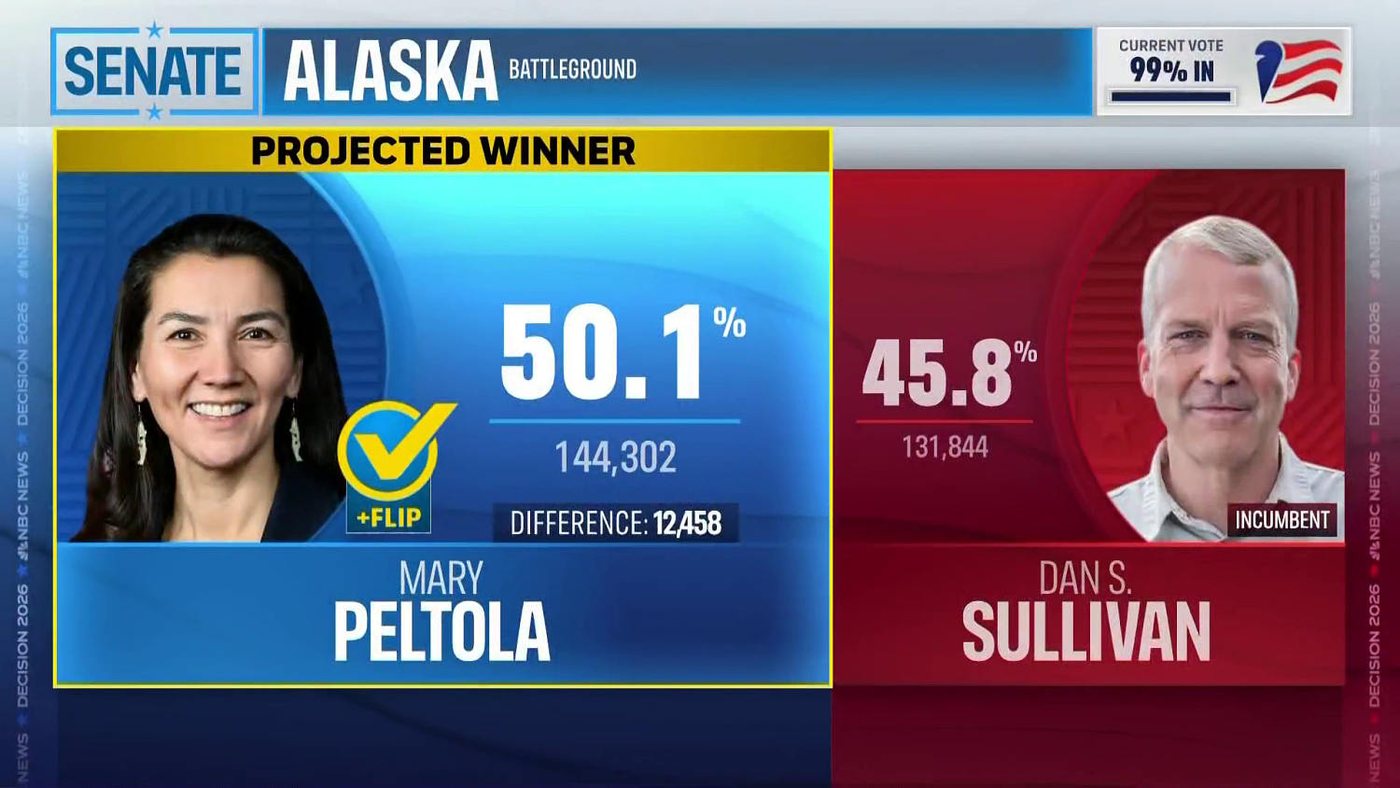
Democrat Mary Peltola has defeated Republican Sen. Dan S. Sullivan in Alaska's Senate race, NBC News projected, flipping a Senate seat that had been held by Republicans in a state that President Donald Trump carried by roughly 13 percentage points in 2024. The win gives Democrats a 56-44 majority in the U.S. Senate, according to reporting on the outcome of the 2026 midterm elections.
The race drew national attention long before the votes were counted. Republicans were defending a seat in a state that has generally favored their candidates in federal elections, while Democrats saw a rare opportunity to make inroads in traditionally Republican territory. The Cook Political Report had rated the contest a toss-up, reflecting how competitive the race had become.
The campaign was also overshadowed by a controversy in the final days before Election Day. The New York Times reported that Peltola campaign aides, attorneys and national Democratic operatives had taken part in a secret effort to recruit a candidate who shared the Republican incumbent's name. According to the report, text messages and interviews pointed to a broader operation, internally dubbed the “ballot composition project,” aimed at recruiting candidates who could draw votes away from Sullivan. The effort reportedly involved the Democratic Senatorial Campaign Committee and included discussions about establishing a new right-wing political party.
Peltola's campaign denied any involvement with either Sullivan campaign, and the Democratic Senatorial Campaign Committee also rejected allegations that it had participated. Republican Gov. Michael Dunleavy responded by ordering an investigation into whether the alleged recruitment effort violated Alaska law. That inquiry adds a legal dimension to a result that was already drawing close scrutiny from both parties.
The ballot itself became a flashpoint. A retired teacher named Dan J. Sullivan, who shared nearly the same name as the incumbent, was on the ballot. Alaska election officials initially moved to remove him amid allegations that his candidacy was meant to confuse voters or siphon support from the senator. He denied wrongdoing, and the Alaska Supreme Court ruled that he could remain on the ballot. The Justice Department also sued in October over the potentially misleading effect of the second Sullivan's candidacy.
The dispute landed in a state with an unusual voting system. Alaska uses ranked-choice voting, which lets voters rank candidates by preference. If no candidate wins a majority of first-choice votes, the lowest-performing candidate is eliminated and ballots are redistributed according to voters' next preferences until a winner emerges. Peltola had previously benefited from that system in her 2022 congressional victories, when ranked-choice tabulation helped decide races with several Republican opponents. The system also meant that the final result was not clear on election night alone, and the outcome was not officially declared until about two weeks after the midterms, according to reporting from the New York Post.
Peltola's path to the Senate has been long and notable. A former state lawmaker, she became the first Alaska Native elected to Congress in 2022, winning a special election to succeed the late Republican Rep. Don Young. She defeated former Republican Gov. Sarah Palin in that contest and won a full term later the same year. She lost her 2024 reelection bid to Republican Nick Begich III, which set the stage for her Senate campaign.
Sullivan, a Marine Corps veteran and former Alaska attorney general, first won his Senate seat in 2014 by defeating Democratic incumbent Mark Begich, the uncle of Nick Begich. He secured reelection in 2020 and sought a third term by emphasizing his experience, national security and Alaska's energy interests. His defeat marks a significant loss for Republicans in a state they have long considered a stronghold, and it represents one of the clearest signs of how the midterm environment played out in competitive Senate races.
Source: nbcnews.com
35