7 minPolitics
Andy Burnham Poised to Become UK Prime Minister After Starmer Resignation
Andy Burnham, a frequent Trump critic and former Greater Manchester mayor, is set to become the UK's next prime minister after emerging as the sole candidate to replace outgoing Labour leader Keir Starmer. His rapid ascent has drawn criticism over lack of scrutiny and mandate.
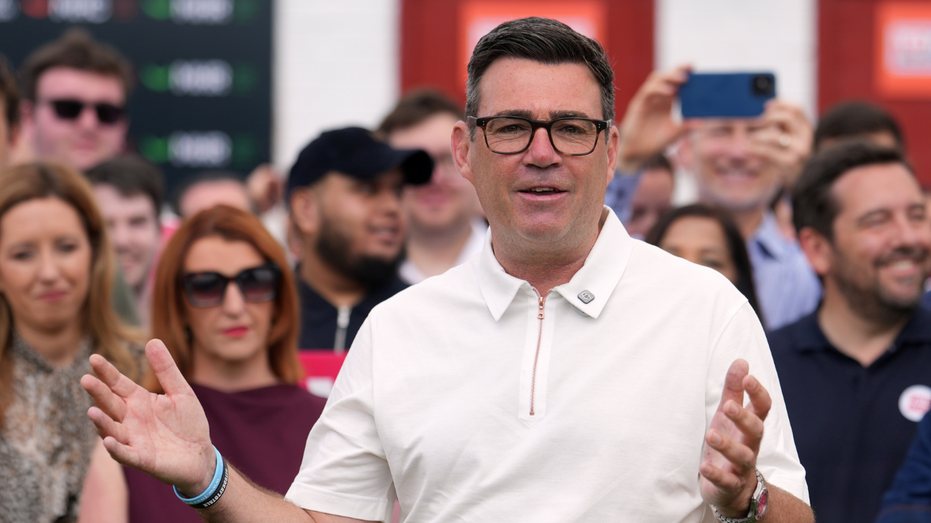
Andy Burnham, the former Greater Manchester mayor who has repeatedly criticized President Donald Trump, is poised to become the United Kingdom's next prime minister after emerging as the only candidate to replace outgoing Labour leader Keir Starmer. Burnham, 56, received nominations from 322 of Labour’s 403 Members of Parliament on the first day of the leadership process, far surpassing the 81 required to enter the contest and leaving potential rivals with virtually no path to qualify. He is expected to be formally confirmed as Labour leader Friday and appointed prime minister by King Charles III on Monday after Starmer’s resignation.
Britain’s parliamentary system allows the governing party to replace its leader — and therefore the prime minister — without holding a national election. The next nationwide election does not have to be held until 2029. Burnham’s rapid path to Downing Street is drawing criticism from political opponents and foreign policy analysts who say he has not faced the scrutiny that would normally accompany either a competitive party leadership race or a general election campaign. Alan Mendoza, executive director of the London-based Henry Jackson Society, told Fox News Digital: «Andy Burnham is the least scrutinized incoming U.K. Prime Minister of recent times. He has faced neither a general election nor an internal party leadership debate in order to establish his positions for wider consumption. He wasn’t even a candidate at the last general election.»
Burnham did, however, win 54.8% of the vote in June’s Makerfield parliamentary by-election, defeating Reform UK’s candidate and returning to the House of Commons after nearly a decade away. Before returning to Parliament, he had been directly elected mayor of Greater Manchester three times. Reform UK leader Nigel Farage argued in a previous interview with Fox News Digital that Burnham should seek a new national mandate. «The public are tired of the game of musical chairs that’s been taking place in 10 Downing Street over the last decade,» Farage said. «Mr. Burnham will come in, he will have no mandate. I don’t even know what his policies are. Literally, I don’t. So, I think for all of those reasons, there ought to be a general election and a fresh mandate.» Farage made the comments before resigning his parliamentary seat this month to trigger an Aug. 13 by-election in Clacton, where he plans to run again. He said he wanted voters to judge him amid parliamentary scrutiny over allegations involving gifts from wealthy supporters. He has denied wrongdoing. Police are separately investigating donations made to Reform UK, but no arrests have been announced.
Burnham grew up in north-west England between Liverpool and Manchester. The son of a British Telecom engineer and a receptionist, he joined the Labour Party as a teenager, studied at Cambridge University and was first elected to Parliament in 2001, according to The Associated Press. He rose through Labour’s ranks during the governments of Tony Blair and Gordon Brown and served in several senior positions, including as culture secretary and health secretary. Burnham ran unsuccessfully for the Labour leadership in 2010 and again in 2015. He left Parliament in 2017 after winning election as mayor of Greater Manchester, a regional position he used to build a national political profile.
As mayor, Burnham promoted greater regional control over transportation and public services. His administration brought Greater Manchester’s fragmented bus system under public control as part of the Bee Network, a regional transportation project that became one of his signature achievements. He also became closely associated with the campaign for accountability over the 1989 Hillsborough stadium disaster, in which 97 Liverpool soccer fans were killed. Burnham supported victims’ families in their long-running effort to expose police failures and rebut false accusations originally directed at supporters.
Burnham has repeatedly criticized President Donald Trump, accusing him of contributing to global instability while warning that Britain risks importing the polarization of American politics. In a 2025 interview with The London Economic, Burnham compared Trump’s return to office to the turmoil caused in Britain by former Prime Minister Liz Truss. «The instability that Liz Truss brought to Britain, I think Trump is bringing to the U.S. and the world,» Burnham said in the interview. He also described several of Trump’s decisions, including his approach to the Russia-Ukraine war, as «out of order.» Burnham’s criticism of Trump dates back to the president’s first election in 2016. After Trump’s victory, Burnham described some of his rhetoric as «deeply troubling» but argued that politicians on the left should examine why working-class voters had turned to him rather than simply blaming the electorate. «We have to look closer to home,» Burnham said, according to The Guardian. His language became sharper following the Jan. 6, 2021, riot at the U.S. Capitol. As the attack unfolded, Burnham wrote on X that «any UK politician who gave Trump the time of day should be ashamed right now.» More recently, during his Makerfield parliamentary campaign, Burnham warned that Britain was moving toward «the politics of the United States of America,» which he described as «a polarized, poisonous politics where people in communities don’t work together anymore.»
Despite the criticism over his lack of a national mandate, Burnham’s supporters argue that his experience as a senior minister and directly elected mayor, combined with his strong by-election performance, gives him the legitimacy to lead. His rapid ascent reflects the Labour Party’s desire for stability after Starmer’s resignation and the broader political turmoil that has seen five prime ministers in the past decade. As Burnham prepares to take office, questions remain about his policy agenda, particularly on economic growth, public services, and foreign relations, including the future of UK-U.S. ties under a leader who has been openly critical of the American president.