5 minNews
Physicist Francis Halzen Wins Nobel Prize for Neutrino Research
Belgian-born scientist Francis Halzen received the Nobel Prize in physics for his work on neutrinos and the IceCube Neutrino Observatory in Antarctica, which detected the first high-energy neutrinos from distant galaxies.
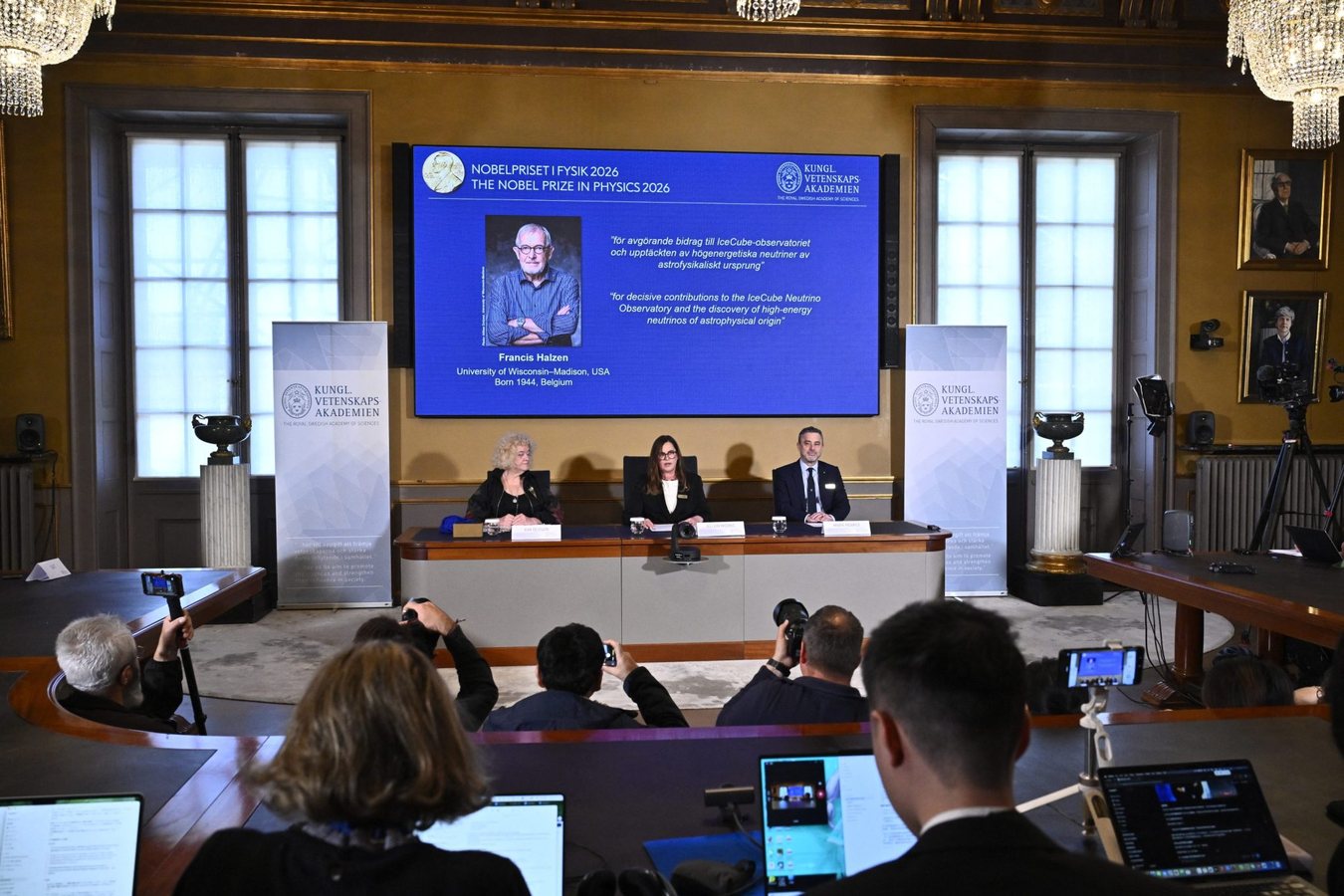
Belgian-born physicist Francis Halzen has been awarded the Nobel Prize in physics for his pioneering work on neutrinos, the elusive subatomic particles that scientists believe hold clues to the evolution of the universe. The Royal Swedish Academy of Sciences announced the award Tuesday in Stockholm.
Halzen, 82, is affiliated with the University of Wisconsin–Madison, which operates the IceCube Neutrino Observatory in Antarctica. The Nobel committee cited his instrumental role in the construction of the observatory, which in 2013 detected the first high-energy neutrinos originating from faraway galaxies. That discovery opened an entirely new field of astronomy.
Neutrinos are among the most abundant particles in the cosmos, yet they are extraordinarily difficult to study. They carry no electrical charge and have almost no mass, allowing them to pass through matter virtually unimpeded. Trillions of them stream through the human body every second, produced by stars like the sun and by violent cosmic events. Because they interact so rarely with other particles, scientists must build enormous detectors to catch the fleeting moments when a collision does occur.
Halzen's insight was to use the vast, transparent ice sheet of Antarctica as a natural detection medium. When a neutrino strikes an ice molecule deep beneath the surface, it produces a faint flash of light. The IceCube observatory captures these signals using sensors buried roughly 8,200 feet (2,500 meters) below the surface, where they are shielded from cosmic rays and other interference. The clarity of the Antarctic ice makes it possible to detect even the weakest signals.
«This experiment in the Antarctic is a revolutionary way of understanding the universe that we didn't have before,» said Michael Moloney, chief executive officer of the American Institute of Physics.
Halzen said he was caught off guard by the news. Speaking by phone from Italy during the announcement, he told the Nobel Physics Committee, «It was a great surprise, and I obviously didn't expect it.» He added that he was working on a proposal and hoped the prize would help get it approved, drawing chuckles from the audience.
The award recognizes a career dedicated to unlocking the secrets of the cosmos through its smallest components. Belgian Prime Minister Bart De Wever said in a social media post that Halzen is the 11th Belgian to win a Nobel Prize, calling the award «impressive recognition for a lifetime dedicated to shedding light on the great mysteries of the cosmos through its smallest components.»
Jonathan Bagger, chief executive officer of the American Physical Society, said the research addresses fundamental questions. «It's all part of working out the story of where we are in the universe, what's our place in the universe, how did our galaxy form?» he said.
The prize money this year is 12 million Swedish kronor, about $1.2 million. Ellen Moons, secretary-general of the Royal Swedish Academy of Sciences, announced the award. She is the first woman to head the prestigious academy and present the prize.
The physics prize is the second of this year's Nobel awards. On Monday, the medicine prize went to three scientists whose work led to a tool that uses light to help unravel how the brain works. The chemistry prize will be announced Wednesday, followed by literature on Thursday and the peace prize on Friday. The Nobel Memorial Prize in Economic Sciences will be announced Monday.
Last year, three scientists won the physics prize for research on quantum tunneling, a phenomenon that enabled the ultrasensitive measurements used in MRI machines and laid the groundwork for better cellphones and faster computers.
Halzen's work has transformed neutrino astronomy from a theoretical ambition into a functioning observational science. The IceCube observatory continues to collect data, and researchers expect it to yield further insights into the most energetic events in the universe, from supernovae to black holes. The Nobel committee's decision underscores the growing importance of multimessenger astronomy, which combines observations of light, gravitational waves, and particles like neutrinos to build a more complete picture of cosmic phenomena.
Officials at the IceCube Neutrino Observatory and the University of Wisconsin–Madison did not immediately respond to requests for comment.
5