5 minNews
FBI Arrests OpenAI Employee Accused of Planting Hidden Recorder in San Francisco Office
Federal agents arrested a Saudi citizen employed as an engineering lead at OpenAI after a covert listening device was found hidden in a conference room used for confidential executive meetings, according to the FBI and the company.
Federal agents have arrested an OpenAI employee accused of planting a sophisticated listening device inside a conference room at the company's San Francisco headquarters, a case that the FBI is treating as a matter of national security and counterintelligence.
The suspect, identified as Abdurahman Alfozan, 35, a citizen of Saudi Arabia, was taken into federal custody on Oct. 9 and appeared in federal court on Tuesday, according to the FBI. He faces a maximum sentence of five years in prison and three years of supervised release if convicted. A detention hearing is scheduled for Oct. 19.
OpenAI's technical surveillance countermeasures team discovered the device on Sept. 30 during a sweep of the conference room, the company said. The recorder had been plugged into a USB port on the back of a television and concealed with a small piece of toilet paper, according to the FBI. The device featured advanced encryption, audio monitoring capabilities, and a data-transfer mechanism designed to evade detection.
The room was regularly used for what the FBI described as discussions of highly confidential technical, commercial, and strategic information, including proprietary research, product plans, business-development opportunities, and nonpublic details about OpenAI's technical progress, government engagements, and commercial relationships.
Alfozan worked as an engineering lead on OpenAI's Agents Platform, according to his professional profiles. He previously spent five years at Meta and graduated from the Massachusetts Institute of Technology in 2016 and the University of California, Berkeley, in 2025.
After the device was found, OpenAI contacted the FBI and worked with investigators on the timing of Alfozan's termination so as not to disrupt the inquiry. The company restricted his access to systems and parts of the office, suspended his network access, placed him on leave, and took back his company-issued equipment. He was fired on Oct. 9, the same day he was arrested.
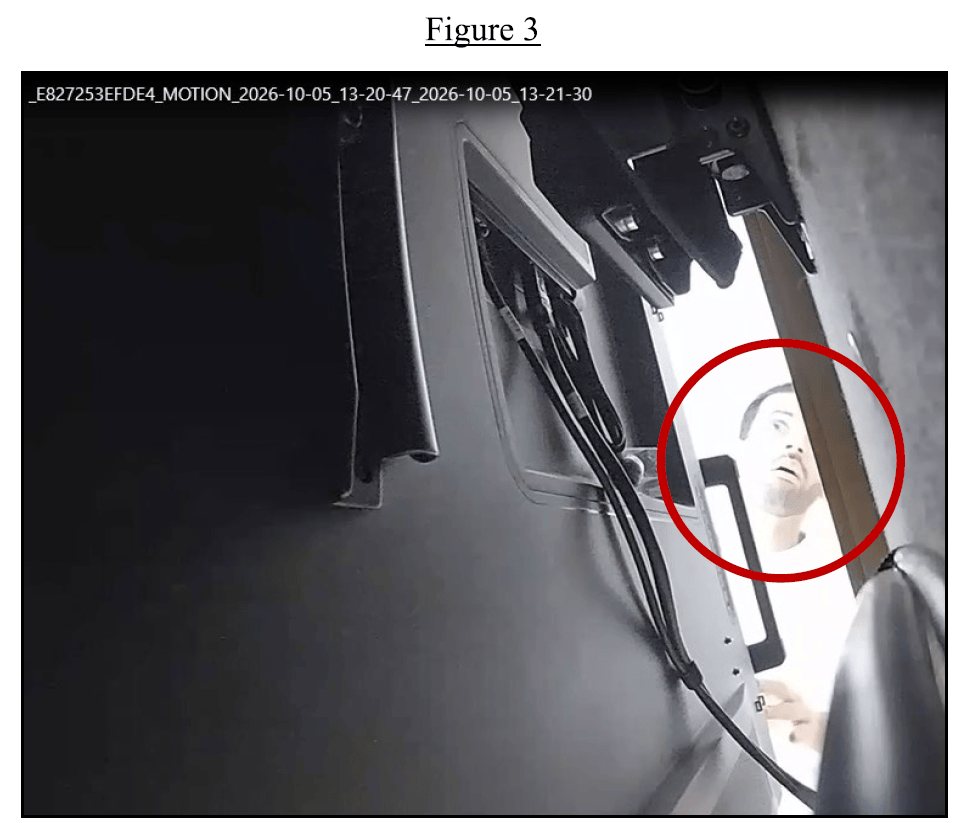
Despite those restrictions, Alfozan allegedly entered the conference room again on Oct. 5 and checked behind the television for the device, which had already been removed, according to the FBI. Closed-circuit television footage captured him inside the office. On or about the same day, he allegedly left an unattended bag in a different room containing his wallet, identification, and another similar recording device. The device pictured in the FBI's release bears the brand Seeed Studio.
Investigators said that between Sept. 24 and Sept. 30, Alfozan consulted an unnamed chatbot using his spouse's account about building, installing, and encrypting audio recordings. He also used an internal productivity tool to seek information about OpenAI's building addresses, meeting rooms, meeting-room capacities and calendars, and the locations of leadership and executive meetings and external partner meetings, the FBI claimed.
OpenAI said it has found no indications that Alfozan inappropriately accessed or exfiltrated model weights, source code, or customer data. The company said it used its own models to understand the device and to identify which employee had planted it. The investigation remains ongoing, and neither OpenAI nor the FBI has found evidence that any information leaked.
FBI Director Kash Patel framed the incident as a national security matter. «Protecting American SI is essential to safeguarding our nation's economic strength and national security, and the FBI views that mission as one of our highest counterintelligence priorities,» he said, using an abbreviation for superintelligence.
OpenAI said it takes the protection of its technology, data, and people seriously and described the matter as one of national importance. The company has pointed to the episode as an example of how its technology can help combat such threats.
The case adds to growing scrutiny of security inside leading artificial intelligence firms, where proprietary research and strategic plans carry enormous commercial and geopolitical value. It also underscores the challenges companies face in monitoring insider access even after suspicions arise.
17