6 minNews
Blue Origin Rebuilds LC-36 for New Glenn's Year-End Return to Flight
Four months after New Glenn exploded on the pad, Blue Origin is racing to rebuild Launch Complex 36 and return the rocket to flight by December, with a Blue Ring spacecraft aboard.
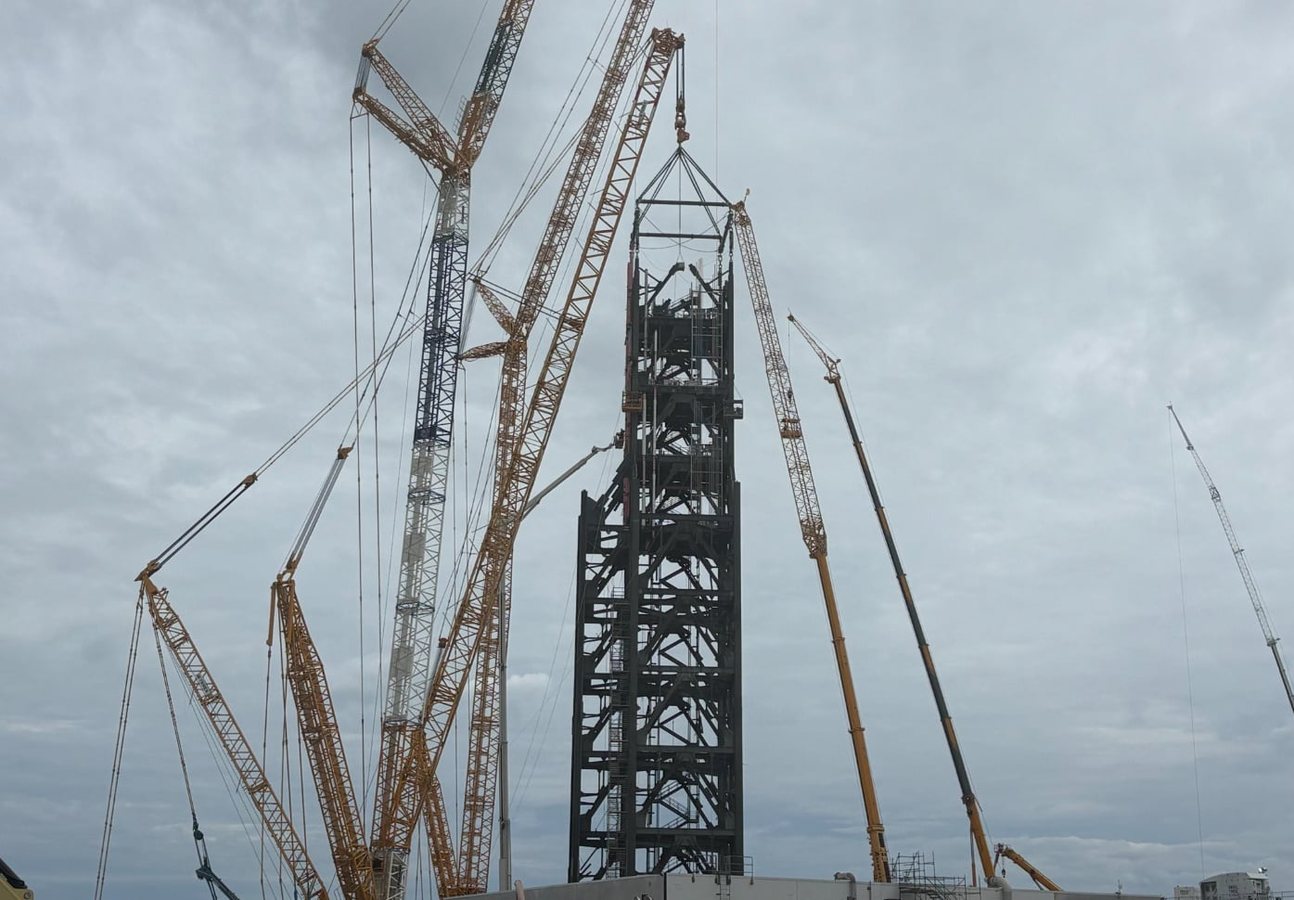
Blue Origin is pressing ahead with reconstruction of Launch Complex 36 in Florida, aiming to return its New Glenn rocket to flight before the end of the year, roughly four months after a catastrophic explosion destroyed the vehicle on the pad.
The company has moved to vertical integration for the rebuilt pad, eliminating the large transporter-erector lost in the blast and relying solely on the support tower to supply propellants and other commodities to the rocket. The approach mirrors operations used with SpaceX's Starship and requires extensive upgrades to the support tower so it can transfer super-cold cryogenic propellant from the tank farm to the vehicle.
According to CEO Dave Limp, the fastest path was to destack most of the tower's modules, repair and upgrade them on the ground in parallel, and then reassemble the structure. Teams have worked on that plan since the summer, adding new floors and guard rails for worker access along with ground support equipment needed to move cryogenic propellant up the tower. That phase is now wrapping up, and the first and second modules have returned to the tower and been stacked by one of the many cranes operating at the site.
Damage extended well beyond the towers. Drone footage shared by Limp in July showed the launch mount and launch bridge collapsed into the flame trench, large slabs of metal and concrete that had supported New Glenn and provided ground interfaces. As with the support tower, Blue Origin sought to reuse as much existing hardware as possible rather than fabricating everything from scratch. Limp said the launch bridge has been restored and is ready for use, with most of the structure salvaged. The main water piping has been reinstalled, and the two rainbirds that form part of the water deluge system are visible. The deluge protects ground infrastructure from the forces of seven BE-4 engines.
Whether pad reconstruction is halfway complete remains difficult to assess. Blue Origin has moved quickly, with substantial hardware already in place. At the same time, much of the new equipment required for the vertical integration concept of operations has not yet appeared, including the hardware that will be bolted to the side of the support tower: umbilical connections to the rocket and rotating platforms for worker access to the fairing.
In an interview with Fox News, Jeff Bezos said the company is targeting December for the return-to-flight mission, which will carry a Blue Ring spacecraft. He noted, jokingly, that the date could end up being December 31. With about 12 weeks remaining until the end of the year, the schedule is tight.
Bezos also confirmed that Blue Origin is building four launch pads. These include LC-36A, which is recovering from the May explosion; LC-36B, a new pad under construction to the north specifically for New Glenn 9×4; Space Launch Complex-14 at Vandenberg, for which documentation has linked Blue Origin; and, according to rumors, Launch Complex-46 at the Cape. LC-46 has previously served as a multipurpose pad for vehicles including Astra's Rocket 3, the Athena family, Minotaur IV, an Orion in-flight abort test, and military missile tests.
With four pads, Blue Origin is seeking approval for weekly launches from LC-36A. Bezos said that once the company is flying weekly, he wants to fly daily; once flying daily, he wants hourly launches; and once launching hourly, he wants launches every minute. He acknowledged that the team considers the goal «crazy,» comparing it to the path toward 100 million Amazon Prime customers. That cadence would equate to 525,600 launches per year, far below the 38.7 million commercial aircraft flights forecast for 2026, but it would involve a single rocket type and four pads rather than multiple aircraft types and thousands of airports.
A more concrete development may involve a crew vehicle. Blue Origin has worked on such a system for years, and recent statements have moved the effort from rumor toward confirmation. In 2012, Blue Origin developed a «Biconic Crew Vehicle» under the Commercial Crew Development program, the precursor to the Commercial Crew Program that selected SpaceX's Dragon and Boeing's Starliner. After wind-tunnel testing and a System Requirements Review, Blue Origin left the program. That was the last public mention of an orbital crew vehicle, though development is understood to have continued out of public view.
Current commercial crew operations feature SpaceX's Dragon, which has flown regular crew rotations every six months plus additional private missions, and Boeing's Starliner, which has faced repeated delays. SpaceX has indicated plans to eventually retire Dragon in favor of Starship. From NASA's perspective, that transition could reduce the number of dissimilar crew vehicles available for International Space Station operations, contrary to the original goal of the Commercial Crew Program.
8