4 minBusiness
SendCutSend Raises Series B at $2.1 Billion Valuation to Expand U.S. Metal Manufacturing
SendCutSend, a Reno-based custom metal parts maker, has raised a Series B led by Spark with participation from CRV, MHS, Sequoia and Paradigm, valuing the company at $2.1 billion just months after a Series A put it at $1.1 billion. Founder Jim Belosic says the capital will go toward payroll, shorter lead times and new locations as the company positions itself as a layer of U.S. reindustrialization.
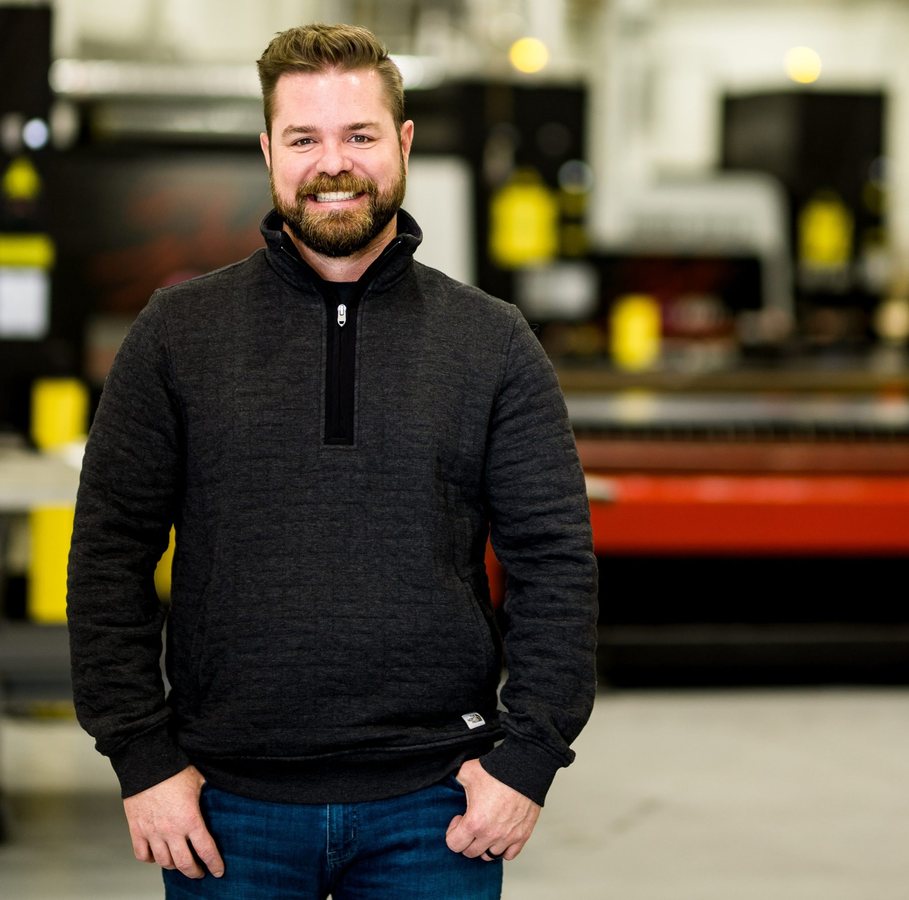
SendCutSend, a Reno, Nevada-based company that turns customer designs into custom metal parts, has raised a new funding round valuing the business at $2.1 billion, roughly five months after a Series A valued it at $1.1 billion. The Series B was led by Spark, with participation from CRV, MHS, Sequoia and Paradigm.
The company was cofounded in 2018 by Jim Belosic, who built it around laser cutting, the process by which a concentrated beam of light slices through materials such as metal. SendCutSend addresses a longstanding gap in manufacturing: getting small runs of custom metal parts made can be difficult or impossible, particularly for customers whose orders are modest in size.
That pitch has drawn a roster of customers including Zipline, Telo Trucks, Neros, Waymo, K2 Space, Relativity, Anduril and Castelion, along with 60% of the Fortune 500, according to the company. Its first order was a set of pickleball keychains, and Belosic said business grew steadily from there.
For years, Belosic avoided venture capital. That changed in the spring, when Sequoia partner Andrew Reed connected with him and flew from San Francisco to Reno. Reed recalled that Belosic told him to wear boots, and within about 14 hours he was bending metal. The resulting Series A valued SendCutSend at $1.1 billion.
Belosic frames the new capital less as a financial engineering exercise than as a way to create jobs. «My favorite use of VC dollars is turning it into mortgages, turning it into baby formula, turning it into onesies, turning it into opportunities for our guys to go from a bicycle to a car,» he said. «I love taking VC dollars and putting it directly in the payroll.»
He described himself as an owner rather than a Silicon Valley entrepreneur, saying he never set out to build a company around «financial gymnastics» toward an IPO. Reed, who has been at Sequoia for more than 12 years, said Belosic built the business to nine digits of revenue without a major institutional venture round, calling it «the ultimate example of suction.» Reed added that the money has a clear use: shorter lead times for customers, new locations closer to customer sites and capacity to take on more work.
SendCutSend's rise comes as venture dollars and public attention increasingly focus on U.S. reindustrialization. Belosic believes the company can serve as a «foundational layer» in that effort, describing a vision in which metal is mined and processed domestically, cut through SendCutSend and then passed to others who add their own layer. «The future of manufacturing will be made in America,» he said.
The company's origin traces to a personal project. In 2017, Belosic was building a steam-powered car from what was once a Ford Model A. He wanted a throttle control with three labeled speeds inspired by the oxen of the computer game Oregon Trail — «steady,» «strenuous» and «grueling» — which required tiny, intricate letters. A friend of a friend laser cut them, and the experience pointed toward the business he would later build.
3