5 minBusiness
Matternet Unveils M3 Drone Delivery System for Restaurants and Retailers
Matternet has introduced the M3, a decentralized drone delivery system that lets businesses like Dave's Hot Chicken plug into a shared network. The company plans a U.S. rollout in the second half of 2027 and a U.K. launch next year, as it competes with Amazon, Wing, Zipline, and China's Meituan in a fast-growing market.
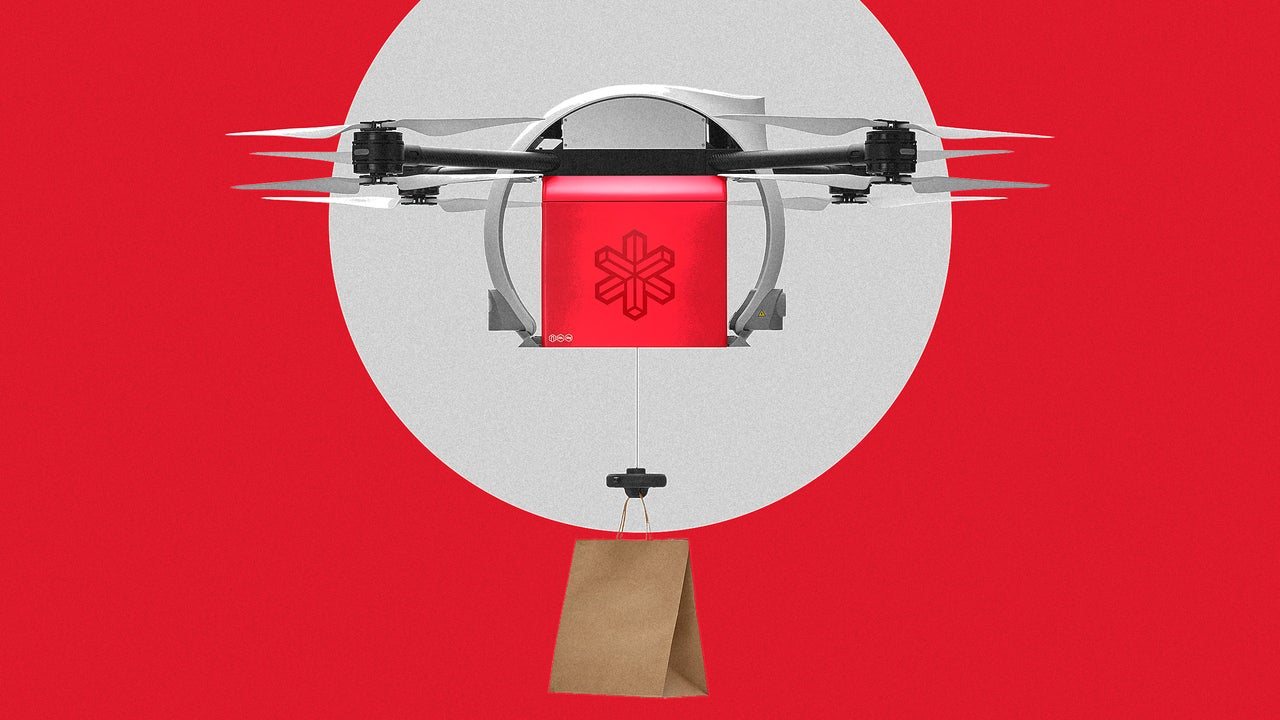
Matternet has unveiled a new drone delivery system that it says could turn aerial logistics into a utility for restaurants, retailers, and hospitals. The Silicon Valley company's M3 architecture is built around a drone that can carry up to 11 pounds, along with simpler, lower-cost dock stations and drop boxes installed on or near a merchant's premises. Matternet plans to roll out the system in the second half of 2027, with Dave's Hot Chicken as its first U.S. partner.
The company's chief executive, Andreas Raptopoulos, describes the goal as making drone delivery «largely invisible, dependable, and low-cost» — something a business connects to «the same way a building connects to water or power.» The M3 is designed to be decentralized. Instead of flying from a centralized fulfillment center, any business can plug into the network. Each merchant gets a dock and a portal, a freestanding drop box where staff can leave a bagged order. A drone then flies to the portal, picks up the package, and delivers it to the customer.
The system has three main parts. The drone carries up to 11 pounds within a 10-mile radius and lands in a dock that stores and charges it. The portal accepts standard food bags, retail boxes, or specialized healthcare packaging. Raptopoulos says each drone completes about four to five deliveries per hour, and the number of drones at a merchant depends on how many deliveries per hour it needs to serve. Because the fleet is shared, Matternet's cloud can reroute idle drones to a store during a demand peak. The company says this removes the empty flights between a central hub and the merchant's pickup point, raising aircraft utilization and lowering cost.
Customers receive an estimated time of arrival, live tracking, and a notification 60 seconds before delivery. A three-mile route takes five to seven minutes after the order is placed in the portal, and Raptopoulos claims the ETA is accurate to within seconds. Delivery happens by tether drop: the drone hovers 30 meters above a marked point, usually the front or back yard, and lowers the package on a cable a few steps from the door. The design is focused on single-family suburban homes, though Raptopoulos says dense cities with more merchants and customers close together would make the M3 even more efficient. He also says the system runs with central supervision from Matternet's airline partners, meaning remote oversight rather than a fully hands-off operation.
Matternet is entering a U.S. drone delivery market that remains nascent and plagued by regulatory hurdles, opposition from residents, and limited availability. Four major players already operate in the space: Amazon Prime Air, Flytrex, Wing, and Zipline. Amazon flies from sites in the Dallas-Fort Worth area, Houston, Phoenix, Detroit, and Tampa, carrying up to 5 pounds within 7.5 miles, and plans to reach suburban communities of nearly 500 cities and towns by the end of 2026. The M3 is at least nine months from commercial service, and Matternet has not provided order or route counts.
China, meanwhile, is moving quickly. Meituan began exploring drone delivery in 2017 and launched its first commercial service in Shenzhen in 2021. It topped 1 million orders worldwide by the end of June and recently launched a dedicated McDonald's route in Shanghai. Beijing's five-year plan aims to commercialize the airspace just above rooftops, and Chinese companies are already expanding their technology overseas. Research firms put the global drone delivery market in 2026 anywhere from $360 million to $5.06 billion, with the latter projecting $20.98 billion by 2034.
Matternet, headquartered in Silicon Valley, plans to deploy the M3 system in the U.K. by next year, partnering with medical logistics company Apian and its existing National Health Service drone delivery network in Central London. Raptopoulos claims the M3 was designed «to deliver the best unit economics in the industry,» but did not provide a cost per delivery or a price for the portal or dock. The company says the portal holds up to three packages, and additional versions are planned, including variants that let merchants send packages without stepping outside.
4