4 minBusiness
Half of US consumers now use AI for local business recommendations
A SOCi study finds that 52% of American consumers use AI tools monthly to find local businesses, up from 9% a year earlier, and that multi-location brands are increasingly absent from those recommendations unless their online profiles are strong.
Local businesses with several storefronts are facing a new kind of competition for customers. According to the SOCi Local Discovery Index, 52% of US consumers now use artificial intelligence to get local recommendations every month, a nearly sixfold increase from 9% one year earlier. For multi-location brands, appearing in those AI-generated answers is quickly becoming as important as ranking in a traditional search.
The study covers about 3,000 US multi-location brands across 44 industries and draws on 3 million local queries and 1.4 million unique source URLs. Researchers asked AI systems to recommend 10 businesses of a given type in a specific market. Brands ranked one through five were classified as likely to be recommended, those ranked six through ten as at risk, and those outside the list as effectively invisible. The tests ran on ChatGPT, Gemini and Claude, with Gemini used as a proxy for Google's AI surfaces. The timing is significant: Google launched its Gemini-powered Ask Maps earlier this year, extending AI-driven answers into the mapping products that many shoppers already use.
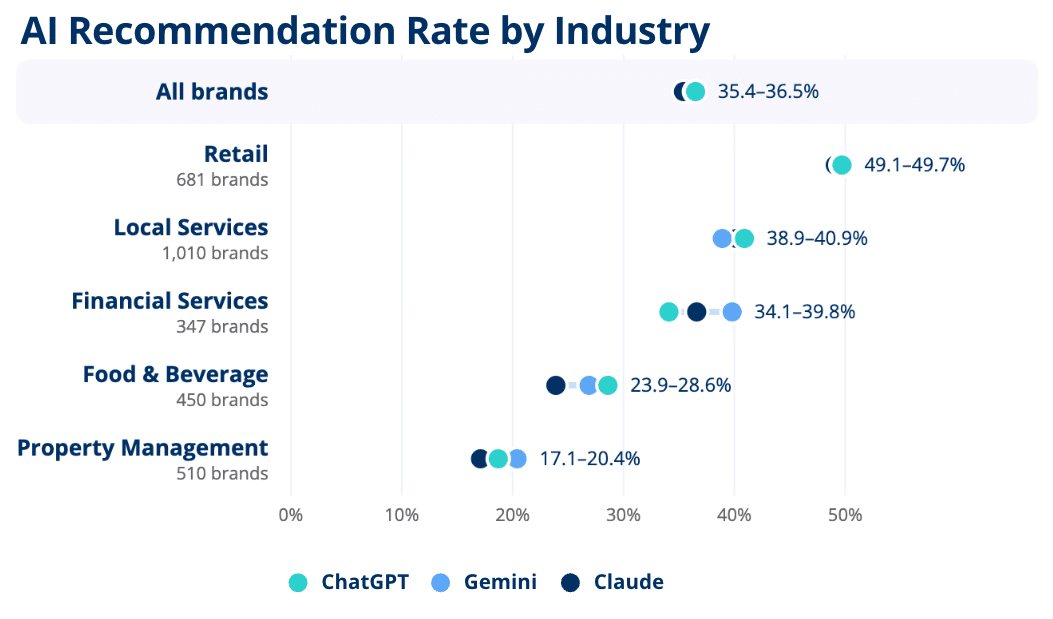
Average AI visibility across the brands tested stands at 36.1%, compared with 7% previously. By comparison, visibility in Google's local three-pack, the block of map results that appears at the top of local searches, is 35.9%, and visibility on Page 1 of Yelp is 37.1%. Visibility varies sharply by sector. Retail and Local Services brands perform best in AI recommendations, while Property Management and Food and Beverage brands perform worst.
Ratings play a role, but they are not the whole story. Recommended brands average about 4.2 to 4.3 stars, while brands in the at-risk tier sit near 4.0. The research found that review volume can offset gaps in rating, although the size of the offset depends on the platform. To match a recommended brand's standing, a business would need about 4% more reviews on ChatGPT, 14% more on Claude and 64% more on Gemini. The difference suggests that a brand's review strategy must be tailored to the AI system in question rather than applied uniformly.
The study also points to where AI systems look for information. Google Maps and Yelp are the leading cited sources for local AI answers, and business websites, particularly local landing pages, rank third. That makes the basic digital footprint of each location a direct input into whether it gets recommended. Yet roughly half of US brands lack a Facebook store page for some of their locations, leaving gaps in a source that AI tools can draw on.
The report recommends four steps: fixing Google Maps and Yelp listings, strengthening business websites, growing review volume, and auditing citations across the web. For brands with dozens or hundreds of locations, the work is largely about consistency, ensuring that every storefront's listing, reviews and web pages present accurate and complete information. Brands that neglect these basics risk falling into the at-risk group or disappearing from AI recommendations altogether, even when they have strong reputations with customers who still search the old way.
Source: martech.org
4