6 minBusiness
Ford CEO Jim Farley Challenges College-First Culture as Skilled Trades Face Completion Crisis
Ford CEO Jim Farley says the air we breathe is a four-year degree, and new data from the Alliance for America's Skilled Trades shows the real problem is not persuading young people to enter trades but keeping them through completion.
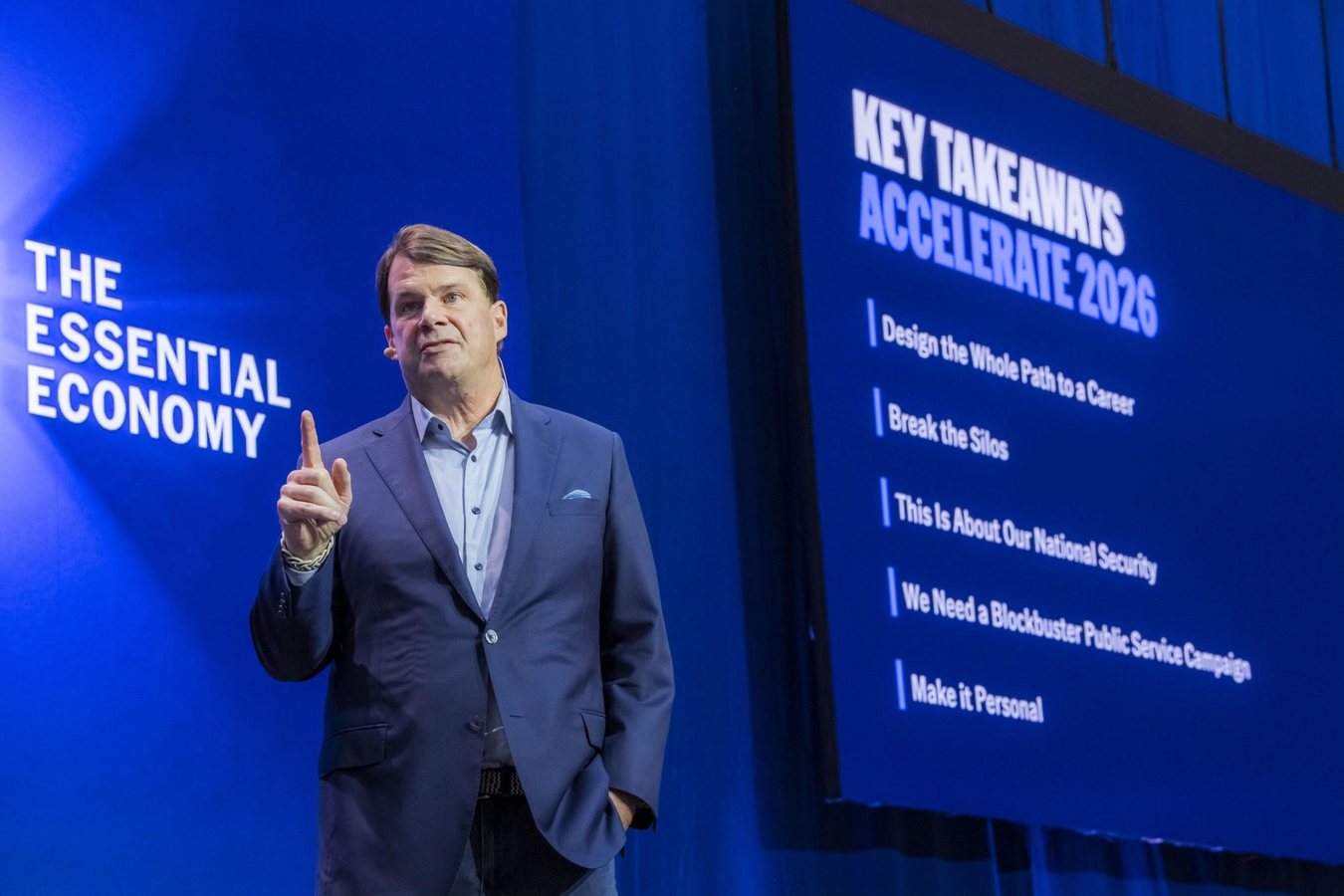
Ford CEO Jim Farley has drawn attention to a problem that has long been hiding in plain sight: the American education system treats a four-year college degree as the default path for every student, while skilled trades are too often presented as a fallback. Farley's critique, captured in the phrase «the air we breathe is a four-year degree,» has been reinforced by new research from the Alliance for America's Skilled Trades, a coalition Ford launched with Google, BlackRock, and Carhartt.
The alliance's latest report offers a detailed look at the country's skilled trades pipeline, and its most widely cited finding is stark: employers will need to fill roughly 1.7 million skilled trades openings every year through 2035. Training programs are currently preparing only about 55 people for every 100 of those jobs. But the more revealing number sits deeper in the report, and it points to a different problem than the one most public conversations address.
Persuasion is not the biggest obstacle. Seventy-one percent of teenagers say they would be proud to pursue a skilled trade, and 81 percent of parents say they would be proud if their child did. The real leak in the pipeline happens after people have already said yes. Of every 100 people who start an apprenticeship, only 48 finish. Five years later, just 29 are still working in a trade. The country is losing young talent not at the point of recruitment but on the way to work.
The reasons people walk away are practical and often financial. Getting to class can require a car payment or a two-hour bus ride. Childcare does not pause for an apprenticeship. Apprentices earn little while they learn, and in some trades they carry costs that employers once covered. Many auto technicians, for example, are paid a set rate per repair regardless of how long the job takes, and they buy their own tools. A new technician who is still learning works more slowly and absorbs the loss. No awareness campaign can fix that math.
Ford's recent investment in getting trades students to class addresses one barrier directly, and that matters. But other obstacles are built into how employers structure work and pay. The report argues that a pathway only holds people if the destination pays enough to make finishing worth it. Employers control that destination, and they also control much of what happens after enrollment.
The International Youth Foundation, which has spent more than a decade building automotive talent pipelines in Mexico and South Africa, has found that people finish when training is designed with the employers who will hire them. In Mexico, the foundation worked with automakers, suppliers, and coatings companies to create technical tracks in automotive painting, tool and die manufacturing, and automation. Those tracks were embedded across 28 campuses of the State of Mexico's technical college system so they would outlast any single grant. An evaluation of graduates from two of those tracks found that 82 percent were employed within five to six months.
What made the model work was not unique to Mexico. Employers helped decide what was taught. Students received mentoring and career guidance alongside technical training. And there was a real job waiting at the end. The report also warns that outdated training is another way the pipeline loses people. A graduate who learned last decade's version of a job shows up unprepared and either does not get hired or does not last. Matt Sigelman of the Burning Glass Institute, which co-produced the report, noted that the jobs most resistant to automation are those built on varied, complex tasks requiring human judgment. That means training must keep pace with the work. When electric vehicle manufacturing arrived in Mexico, the foundation worked with the National Auto Parts Industry Association to define what the new jobs required and built training around those standards.
The report's recommendations focus on accountability. Every alliance member should publish completion and five-year retention rates for the training programs it funds or runs, so the public can see which programs actually get people to work. Employers should be inside public technical schools co-writing curriculum rather than building parallel programs on the side. They should pay people while they learn and cover the tools the job requires. With DEWALT and Milwaukee Tool among the alliance's newest members, the companies that make those tools are now at the table.
The central message is that the country does not need to convince young people that the trades are worth pursuing. They already believe it. The task is to make sure the ones who say yes make it all the way to work.
4