4 minBusiness
Designers say AI exposes a 20-year UX problem rooted in past hiring booms
UX job postings have fallen 71 percent from their 2022 peak, and industry veterans argue the current downturn repeats cycles from the dot-com bust and the bootcamp boom.
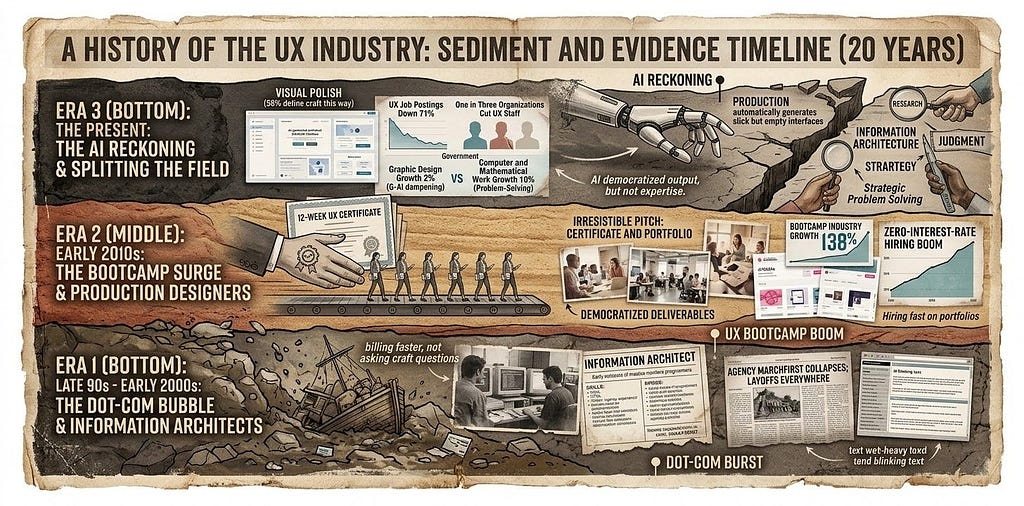
The user experience field has been through three cycles of rapid expansion and sharp contraction in roughly twenty years, and the current downturn is widely blamed on artificial intelligence. Some designers argue the more accurate explanation is older and points to the industry's own habits. Jeff Sauro and Jim Lewis found that UX job postings are down 71 percent from their 2022 peak, with research roles falling even further. They also found that one in three organizations cut UX staff in a single year, the worst reading on record and worse than the period after the 2008 financial crisis.
When companies trimmed their teams, UX roles took a larger share of the cuts than their headcount would predict. The prevailing explanation holds that AI tools have become capable enough to perform design work, leaving many designers facing automation. Prakash Shukla and his colleagues analyzed more than 120 articles and discussions from the UX community and found that fear of being de-skilled and replaced ran through much of the conversation. The author of the source piece contends that this framing misses the historical pattern, which predates generative AI.
The argument rests on two earlier episodes. In the late 1990s, during the dot-com boom, the role then called information architect, responsible for how a product works and how users move through it rather than only how it looks, became highly paid. Agencies hired quickly, many people entered the field without the judgment the work required, and when the bubble burst, large interactive agencies that had grown by acquiring other firms collapsed and layoffs spread widely. The author, then about twenty-five and working at one of those consultancies, says he watched many colleagues lose their jobs and at the time privately believed some had never been true designers. He now describes that view as only partly right, since a boom draws in people who cannot yet do the core job and losing work is not a judgment of talent.
The second cycle came with the bootcamp boom, which began in the early 2010s. A large industry promised to train people as UX designers in weeks, and one count put growth in the coding and design bootcamp sector at 138 percent in a single year. Schools advertised high placement rates, and during the low-interest-rate period many graduates were hired. When the market tightened, the same programs began laying off staff, pausing courses, and in some cases closing, leaving graduates to compete for a shrinking number of junior roles against experienced designers who had been laid off. The source notes that critics within the UX community warned during the boom that short programs produced vocabulary without judgment and that hiring on certificates and portfolios selected for the wrong qualities.
The source's central claim is that the current reckoning is the third iteration of the same problem. AI, in this account, has democratized the production of visual output but not expertise, and the difference between producing something and knowing whether it is good has always been the real skill. The author argues that the industry has long taught many people that design means appearance, and that AI now produces finished-looking work with unusual ease, exposing that gap. The source also insists that the field should be honest about its own role in building the conditions now being revealed, before attributing the downturn entirely to machines.
9