5 minBusiness
AI Budgets Outpace Proof of ROI as Martech Teams Struggle to Scale Agents
Two-thirds of enterprise organizations now have dedicated AI budgets, but only 10.8% of agent initiatives are fully scaled in production, according to The Martech Weekly's Enterprise Martech Outlook 2026. The gap between spending and demonstrable financial returns is widening, with 40.2% of martech leaders unable to show a clear contribution from their technology investments.
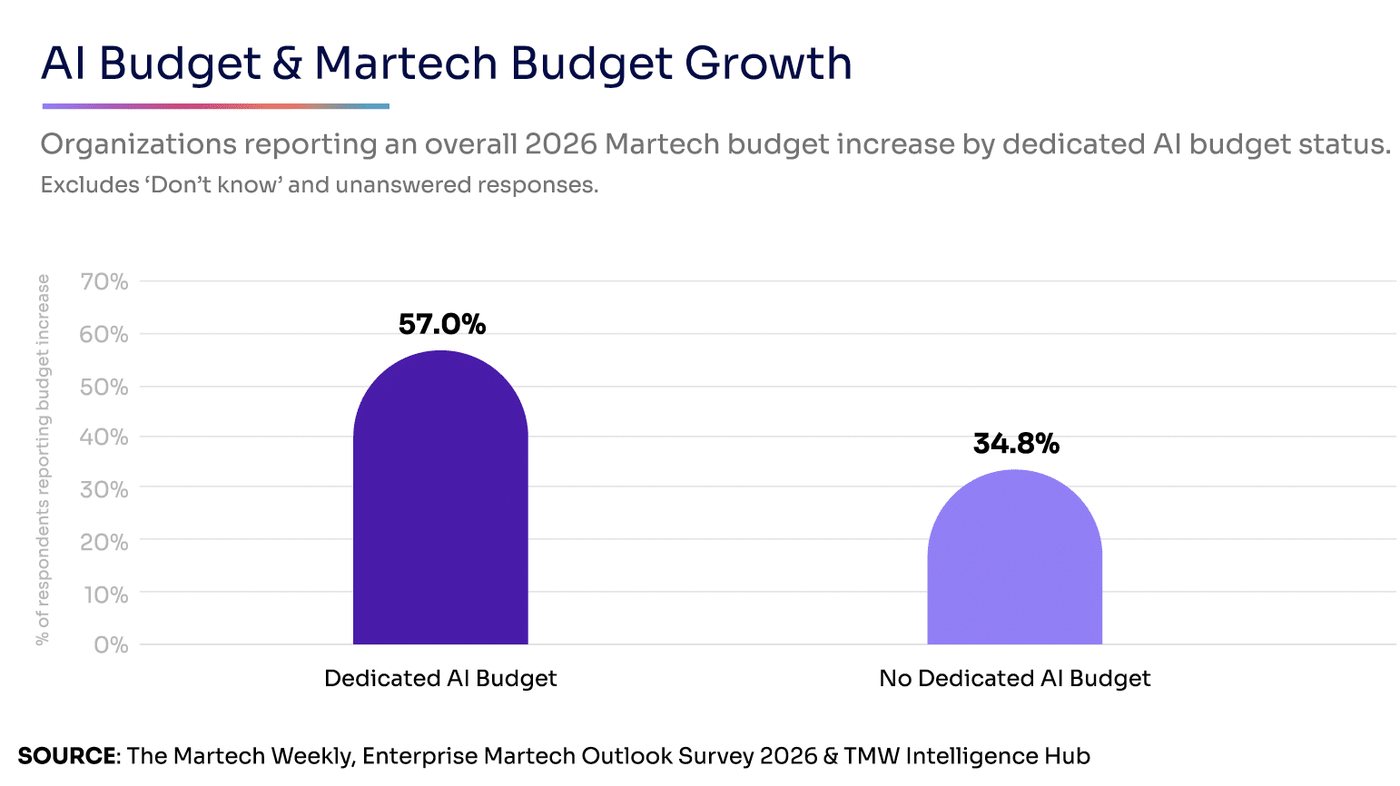
Enterprise spending on artificial intelligence is accelerating far faster than marketers can demonstrate its financial value, according to new survey data that exposes a widening gap between investment and measurable returns. Two-thirds of enterprise organizations now maintain dedicated AI budgets, and 95.3% have AI agents somewhere on their roadmaps, yet only 10.8% of agent initiatives have reached full-scale production.
The findings come from The Martech Weekly's «Enterprise Martech Outlook 2026» report, which surveyed martech leaders about their AI adoption, spending, and measurement practices. The picture that emerges is one of companies spending heavily, experimenting broadly, and struggling to prove that the money is producing results.
Nearly 90% of organizations remain stuck in planning, proof-of-concept, or limited-production stages for their AI agent initiatives. Autonomous marketing, in which AI systems execute campaigns and make decisions without human intervention, remains a distant prospect for most enterprises.
The difficulty is not getting an AI agent to produce an answer. It is being certain that the answer is true. Journey optimization, decisioning, attribution, and campaign creation all inherit data streams and processes that were already complicated before AI entered the picture. When the underlying workflow is shaky, an agent tends to make it shaky faster.
AI is making a more visible dent in marketing operations than in customer experience. Some 69.3% of respondents say AI is having a reasonable, clear, or substantial impact on the martech stack, while only 59.9% say the same about customer experience. That gap reflects where the technology works best right now: internal uses such as writing, editing, analysis, reporting, and creative variation are easier to test, govern, and fit into existing workflows.
The same pattern holds for specific agent applications. Co-pilots, copywriting and editing tools, data management, data analysis, and video generation are further along in production and report better returns. Journey optimization, decisioning, audience selection, campaign creation, attribution, loyalty optimization, and offer agents still have more ground to cover.
Enterprise brands appear to understand AI's limits and risks. They are willing to use it broadly, but most still want a human between the model and the customer. Just 1.6% allow fully automated AI-generated customer-facing content. Most organizations, 43.3%, permit external use of AI-generated content only after it has been reviewed, edited, and verified. Another 24.4% restrict generative AI to internal use only.
That caution creates its own economic problem. The high cost of AI was supposed to be justified by increased worker productivity, but there is no net gain if time saved on production is spent verifying the output. The technology still has to survive the budget meeting.
The broader martech measurement problem has not disappeared just because AI now has its own budget line. Some 40.2% of martech leaders say they cannot demonstrate a clear, measurable contribution to financial objectives or accepted financial proxies. Teams that could prove value were far more likely to report budget growth: 56% received increases, compared with 37.5% among organizations relying on what the report calls «faith-based» value demonstration.
AI may receive special treatment during the investment phase, but it ultimately enters the same budget conversation as every other technology purchase. That places the burden on marketers to distinguish between AI that makes work better and AI that merely makes more work happen. The first group is easier to defend because the result is visible. The second tends to disappear into vague claims about productivity, transformation, or future potential.
Dedicated AI funding remains plentiful. The harder currency is proof.
6